The Trump administration has reportedly considered restrictions on Chinese AI models after Moonshot AI’s 2.8-trillion-parameter Kimi K3 topped a major coding leaderboard and drew growing interest from US companies.
Summary
- Trump officials are reportedly reconsidering restrictions on Chinese open-source AI models.
- Moonshot’s Kimi K3 topped a coding benchmark and attracted strong developer demand.
- Polymarket traders see a low probability of Washington broadly blocking Chinese models.
According to Axios, parts of the administration have renewed efforts to place de facto limits on foreign open-source models as Kimi K3 gains traction among developers. No formal ban has been announced, and the report did not identify a final policy under consideration.
People involved in the debate have previously discussed adding Chinese AI laboratories to the Commerce Department’s Entity List, Axios reported. Such a designation could restrict the companies’ access to US technology unless they receive government licenses, although earlier proposals were paused over concerns that they could slow domestic AI development.
Pressure inside Washington has risen as American businesses test Chinese systems that offer capable performance at lower prices, according to Axios. Open-weight models also let companies download their trained parameters, run them on private servers and adapt them without relying on the original developer’s platform.
Moonshot plans to publish Kimi K3’s full model weights by July 27, according to a report by crypto.news. Once available, those files could make a sweeping US restriction harder to enforce because developers may copy and host the model outside Moonshot’s services.
Demand has already tested the Chinese company’s infrastructure. Reuters reported that Moonshot temporarily stopped accepting new Kimi subscriptions after usage exceeded its available computing capacity, forcing the company to prioritize existing paying customers.
Founded in 2023 by AI researcher Yang Zhilin, Moonshot has raised more than $5.5 billion and was valued at $30 billion in June. The Beijing-based firm is also preparing for a possible Hong Kong initial public offering, with Goldman Sachs and China International Capital Corp involved as advisers.
Kimi K3’s coding performance has given US officials another reason to examine China’s progress. Arena placed the model first in its Frontend Code Arena with 1,679 points, while other tests put it near leading systems from OpenAI and Anthropic.
Reacting to the result, former White House crypto and AI czar David Sacks described the ranking as a warning for the United States.
“This is concerning,” Sacks wrote on X, noting that Kimi K3 had taken first place in the frontend coding test and performed at or near the frontier on other benchmarks.
CIA Director John Ratcliffe has raised separate national security concerns around powerful AI systems. During an AWS event in June, Ratcliffe compared frontier models to “digital nuclear weapons” and placed emerging technology alongside China among the agency’s main priorities, according to The Record.
Traders price a low chance of a US ban
Prediction-market traders remain doubtful that Washington will remove public access to a major Chinese model. Polymarket contracts cited in the original report assigned a 15% probability to federal action that would broadly block such access before the market’s deadline.
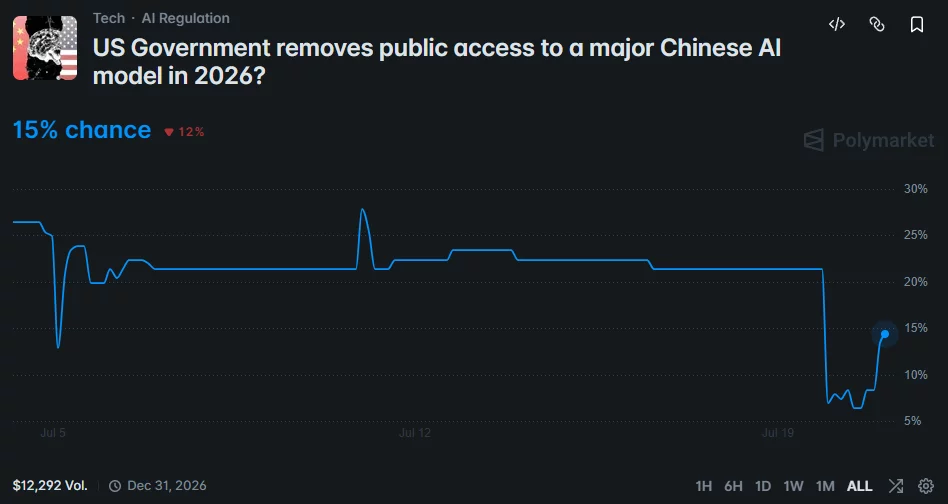
The contract’s price does not measure whether individual agencies or states will stop employees from using Chinese tools. It instead tracks a federal measure, including legislation, an executive order, or another formal action, that generally prevents the US public from accessing a major Chinese model.
In a separate Polymarket contest over which company will operate the best AI model at the end of August, traders gave Anthropic a 91% probability. Moonshot received only 1%, showing that bettors did not treat Kimi K3’s coding victory as proof that it would lead across all model rankings.
Those odds may change as independent developers test the downloadable version after July 27. Kimi K3’s open weights could increase adoption, while any White House proposal could raise the market-implied chance of restrictions.
Bitcoin offers a scarcity counterpoint to the AI boom
The US-China contest is unfolding as investors commit large sums to chips, software, data centers and computing capacity. As previously reported by crypto.news, Binance founder Changpeng Zhao contrasted that investment cycle with Bitcoin’s fixed supply after JPMorgan CEO Jamie Dimon projected that AI-related spending would attract $725 billion this year.
In a recent X post, Zhao argued that AI and Bitcoin serve different economic purposes. According to CZ, AI can raise productivity and improve company operations, while Bitcoin gives holders access to an asset whose total supply cannot exceed 21 million coins.
Equity investors still depend on an AI company’s revenue, execution and ability to compete, Zhao noted. Those companies may also sell new shares to finance expansion, diluting existing holders, whereas no company or government can increase Bitcoin’s protocol-defined cap.
Former Fidelity fund manager George Noble has added a more bearish view of the spending cycle, warning that the fallout from an AI bubble could be 17 times worse than the dot-com collapse. Noble’s projection remains an individual assessment rather than a confirmed market outcome, but it adds financial-market risk to Washington’s concerns over Chinese competition and control of advanced models.