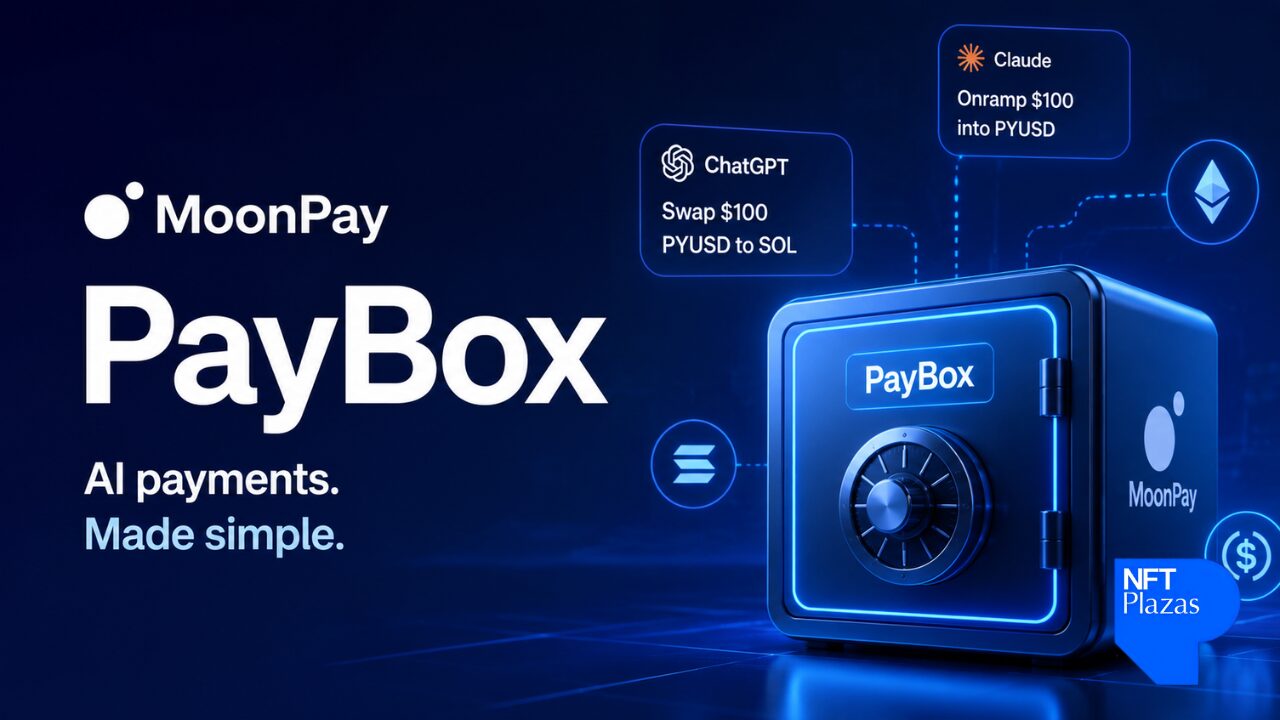
MoonPay has unveiled PayBox, a new AI-native payment vault that enables ChatGPT and Claude users to securely execute cryptocurrency transactions, interact with decentralized finance (DeFi) protocols, and even make real-world purchases without leaving the conversation. The company says the product is designed to transform AI assistants from tools that provide recommendations into agents capable of carrying out financial actions while keeping users in control of their funds.
The launch marks another milestone in the growing “agentic commerce” movement, where AI can complete tasks on behalf of users instead of simply answering questions. By connecting PayBox to ChatGPT or Claude through a custom connector, users can issue natural language commands such as “Onramp $100 into PYUSD,” “Swap $100 of PYUSD to SOL,” “Bridge funds to Robinhood Chain,” or “Maximize yield using Aave.” The AI prepares the transaction, and the user authorizes it with a passkey before funds are transferred.
Beyond crypto transactions, PayBox also enables AI assistants to book flights, reserve restaurant tables, and shop online through integrations built on x402, an open standard for agent-initiated internet payments. MoonPay says additional merchant and service integrations will be introduced over time.

MoonPay Launches PayBox
Bringing payments directly into AI conversations
Until now, conversational AI platforms such as ChatGPT and Claude could help users analyze markets, compare investment opportunities, or explain blockchain protocols, but users still had to switch to exchanges, wallets, or payment platforms to complete every transaction.
PayBox aims to eliminate that extra step by embedding payment functionality directly inside the AI interface. Users can trade cryptocurrencies, bridge assets across blockchains, interact with DeFi protocols, and make payments without leaving the conversation, while retaining final approval over every transaction.
At launch, PayBox supports Solana and several Ethereum Virtual Machine (EVM)-compatible networks, including Ethereum, Base, Arbitrum, Polygon, Hyperliquid, Robinhood Chain, and Tempo, with additional blockchain support planned in future releases.
Security built around user control
MoonPay says security was the primary consideration in designing PayBox. Rather than storing private keys in a single location, the platform uses multi-party computation (MPC) and trusted execution environments (TEEs) to split wallet credentials across secure environments. As a result, neither MoonPay nor the AI assistant can independently access a user’s wallet or authorize transactions.
The infrastructure is powered by Sodot, the Israeli key management company MoonPay acquired earlier this year. According to the company, Sodot secures more than $50 billion in digital assets across over 10 million crypto wallets, and its technology now underpins every PayBox vault.
For card payments, PayBox integrates Visa’s agentic commerce protocol, allowing AI to complete purchases without exposing or storing raw card details. Every passkey authorization is limited to a single transaction, preventing approvals from being reused or replayed if compromised.
Balancing automation with human oversight
PayBox offers users two permission models. Always Ask requires passkey approval before every transaction, ensuring that users manually authorize every payment or crypto transfer. Alternatively, Autonomous mode allows AI to execute transactions automatically within predefined limits, such as spending caps or approved transaction types.
MoonPay says users can modify or revoke permissions at any time, but any changes require fresh human authentication. The company argues this approach removes the tradeoff found in many AI payment solutions, where users must surrender custody of their assets to a centralized platform before automation becomes possible.

Balancing automation with human oversight
MoonPay expands its AI ambitions
PayBox is the latest addition to MoonPay’s broader AI strategy. Earlier this year, the company introduced an open AI wallet standard backed by organizations including PayPal, the Ethereum Foundation, and the Solana Foundation, followed by tools that enabled cryptocurrency purchases and wallet interactions through AI assistants. PayBox extends those capabilities by allowing the entire payment workflow to occur inside the conversation.
The company has also released a software development kit (SDK) that enables developers to integrate PayBox into their own AI applications and plans to expand support to additional AI platforms while adding more advanced DeFi features, including perpetual futures trading and liquidity management.
MoonPay CEO Ivan Soto-Wright described conversational payments as the next evolution of digital finance.
“The card hid the cash. The phone hid the card. This is the era where money disappears into conversation,” Soto-Wright said, adding that billions of AI agents will require secure infrastructure to hold, move, and spend money safely.
To encourage adoption, MoonPay is also offering a USDC airdrop for eligible early users, with rewards of up to 500 USDC per account based on campaign requirements and account eligibility.
As AI assistants continue evolving beyond chatbots into autonomous digital agents, PayBox highlights how conversational interfaces may become the next gateway for cryptocurrency trading, decentralized finance, and everyday online commerce.