Key Takeaways
- Gov. Greg Abbott’s Aug. 3 audit delayed ERCOT’s data center classifications.
- ERCOT’s 474 GW queue is about 90% data centers, putting pending projects at risk.
- PUCT’s Aug. 20 meeting could determine when ERCOT’s Batch Zero process resumes.
The following guest post comes from Ziven.io, a public markets intelligence platform delivering data on companies exposed to bitcoin mining, artificial intelligence, and crypto treasury strategies. Originally published on August 7, 2026, by Cindy Feng.
Texas is a trending destination for data centers, from Bitcoin mining to AI infrastructure. So any regulation changes there can read as breaking, and some panic selling happened earlier this week when Governor Abbott directed an ERCOT audit.
Should you be concerned if your invested companies have major data center footprint in Texas? Let’s read between the lines.
The Power System in Texas: ERCOT Basics
Most of the United States runs on two large interconnected networks, but Texas stands apart on its own separate grid, managed by a nonprofit called ERCOT (the Electric Reliability Council of Texas). It doesn’t own power plants or transmission lines. Rather, ERCOT acts as the system traffic controller: matching supply to demand second by second and deciding which users can connect.
To draw a large amount of electricity, an applicant must apply to ERCOT first. The organization then studies whether the local lines can carry the extra load without destabilizing service for everyone else. Those studies take months. Only after clearance does the applicant sign an interconnection agreement, the contract that grants the right to draw power.
Everyone waiting for a study sits in the interconnection queue. Standing in that line used to cost almost nothing, so the backlog exploded. On July 29, ERCOT told the Texas Senate that pending requests had reached roughly 474 GW, about 90% of them from data centers. The highest electricity demand Texas has ever recorded is 91,089 MW. The queue now stands at more than 5 times that record peak.
Texas had already tried to fix the backlog. Senate Bill 6, enacted in 2025, requires any project above 75 MW to prove site control and post financial security per megawatt. The Public Utility Commission of Texas (PUCT) later set that security at $50,000 per megawatt. That is roughly $25M for a 500 MW campus.
On June 18, PUCT approved ERCOT’s Batch Zero framework, the first coordinated study of all large-load projects under the new rules. Instead of reviewing applications one by one, ERCOT groups the qualifying projects, studies their combined impact on the grid, and classifies each one. After applicants posted the required security, roughly 205 GW of requests qualified in July. Classification notices were scheduled for August 7, 2026, telling each applicant which category it had landed in and whether it would receive a real path to power.
What Governor Abbott Ordered, and What It Changed
On August 3, Governor Abbott directed the PUCT and ERCOT to audit every data center still moving through the interconnection queue. The review covers power draw, on-site generation, water usage, tax incentives, ownership and community impact. Projects that fail to comply “must be denied connection to the Texas grid”. This order followed his June 10 letter urging steps to keep households from subsidizing data center infrastructure.
In response, ERCOT issued Market Notice M-A080326-01. It announced that August 7 classification notices would not go out as scheduled. Instead, ERCOT will ask the PUCT for permission to miss the deadline at the commission’s open meeting on August 20.
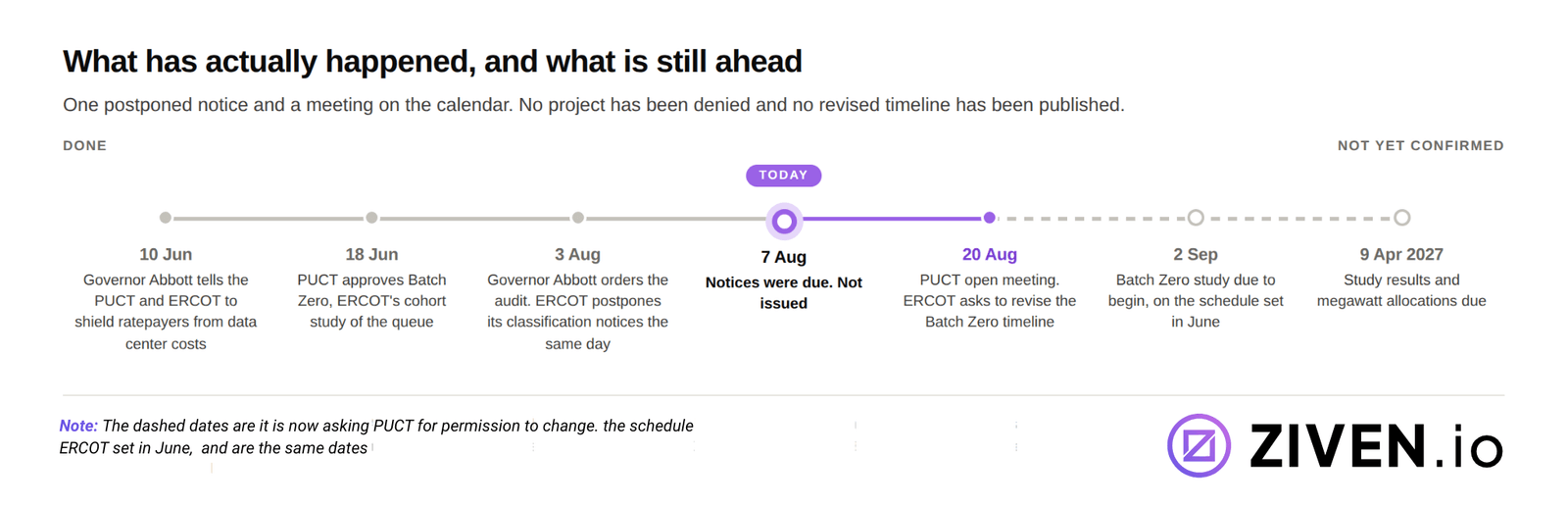
The concrete effects so far remain limited. The governor cannot freeze interconnections on his own, and the PUCT has issued no order. No project has been denied. What exists today is one voluntary postponement of a single administrative notice and a meeting on the calendar.
Who Is Actually Affected?
The audit only applies to projects that are still advancing through the interconnection process. It doesn’t reach back to capacity that has already cleared.
That splits the market into three groups:
Already through
If a company’s Texas capacity has completed its studies, signed its interconnection agreement, or energized its substation, it will be not touched. With the door now harder to walk through, approved Texas capacity has arguably become scarcer, a point Bernstein made to clients the day after the directive.
Still in line
If a company’s growth plan depends on a Batch Zero allocation it hasn’t received yet, its 2027 timeline is now genuinely uncertain. Nothing has been cancelled yet but it’s hard for companies to provide guidance on revenue.
Building their own power
Some operators plan to generate electricity on-site rather than draw from the grid, usually with natural gas turbines. Those projects look structurally unaffected by the administrative notice.
Companies with a footprint in Texas can be sorted into these buckets based on what each has actually disclosed:
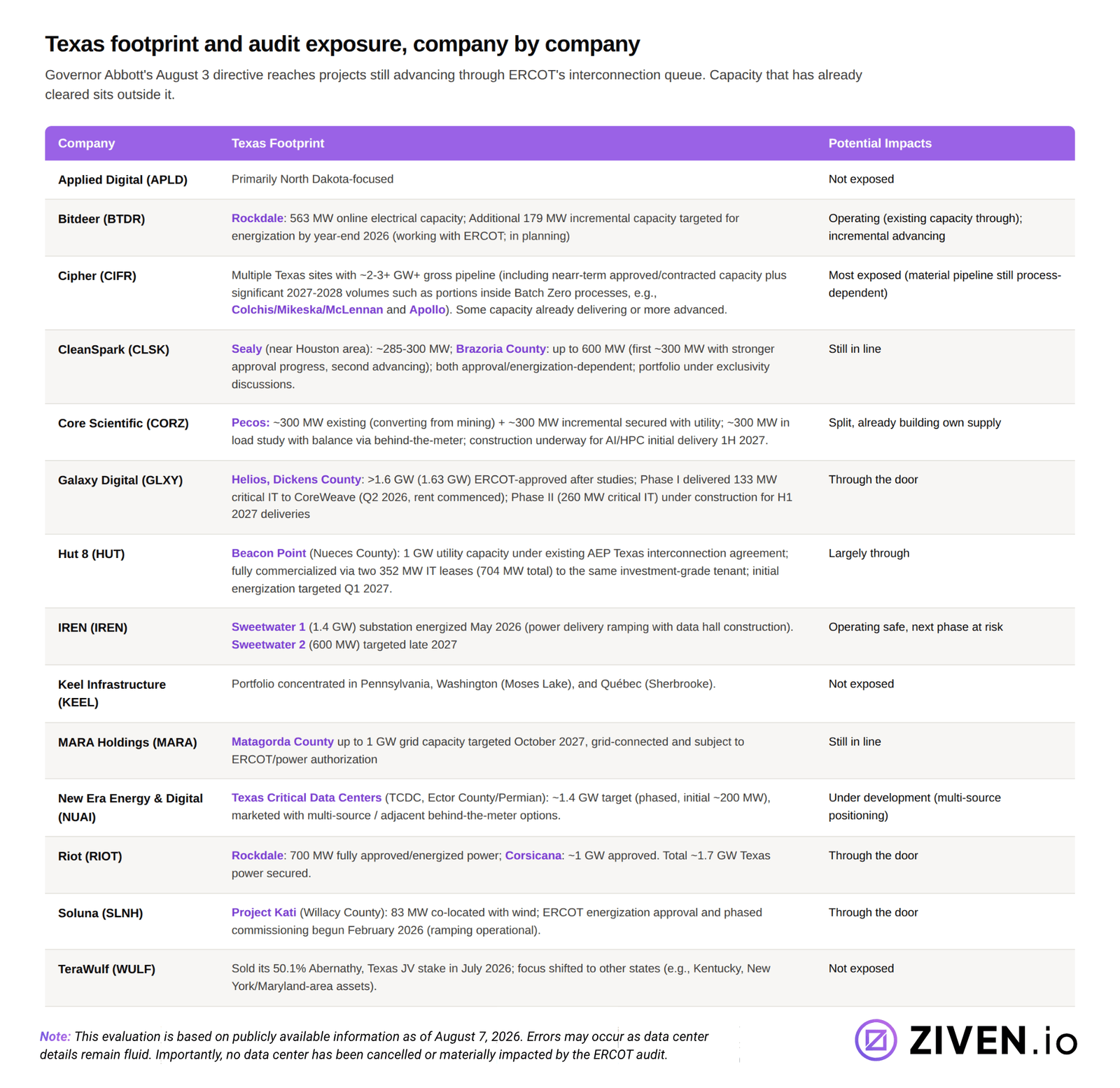
Sell-side reaction so far has been name-by-name rather than a blanket Texas markdown, with target-price trims aimed at pending capacity. As of this writing there have been no downgrades to sell and no announced project cancellations.
About the “Build Your Own Power” Approach
The build your own power approach has been heavily discussed this week. It is directionally sound, but outcomes really depend on specific setups.
Fully independent generation
Projects that build new gas turbines, solar, or storage on site, sized to power the facility, and never touch the grid sit in the cleanest position. New Era Energy is pursuing this in Ector Country. With no interconnection request on file, the audit has nothing to review.
Generation plus grid connection
Most large projects want both: on-site power for economics and a grid tie for backup. The grid portion still requires an interconnection request, so the audit applies. New generation gets easier treatment than existing plants. Senate Bill 6 requires extra PUCT approval only when a data center connects to a plant already running as of September 1, 2025. Turbines built new for the site do not trigger that rule.
Co-location next to an existing plant
This looks cheapest on paper but is hardest in practice. A recent case: On July 23 the PUCT approved a 265.5 MW Armstrong County wind farm serving two co-located Crusoe data-center loads. The entire 525.5 MW load must shut off within 30 minutes of an ERCOT emergency order, with no pay and no access to paid demand-response programs. The developer asked to curtail only 265.5 MW (the wind farm’s output). The Commission refused, saying any load left running would simply take that power and defeat the curtailment.
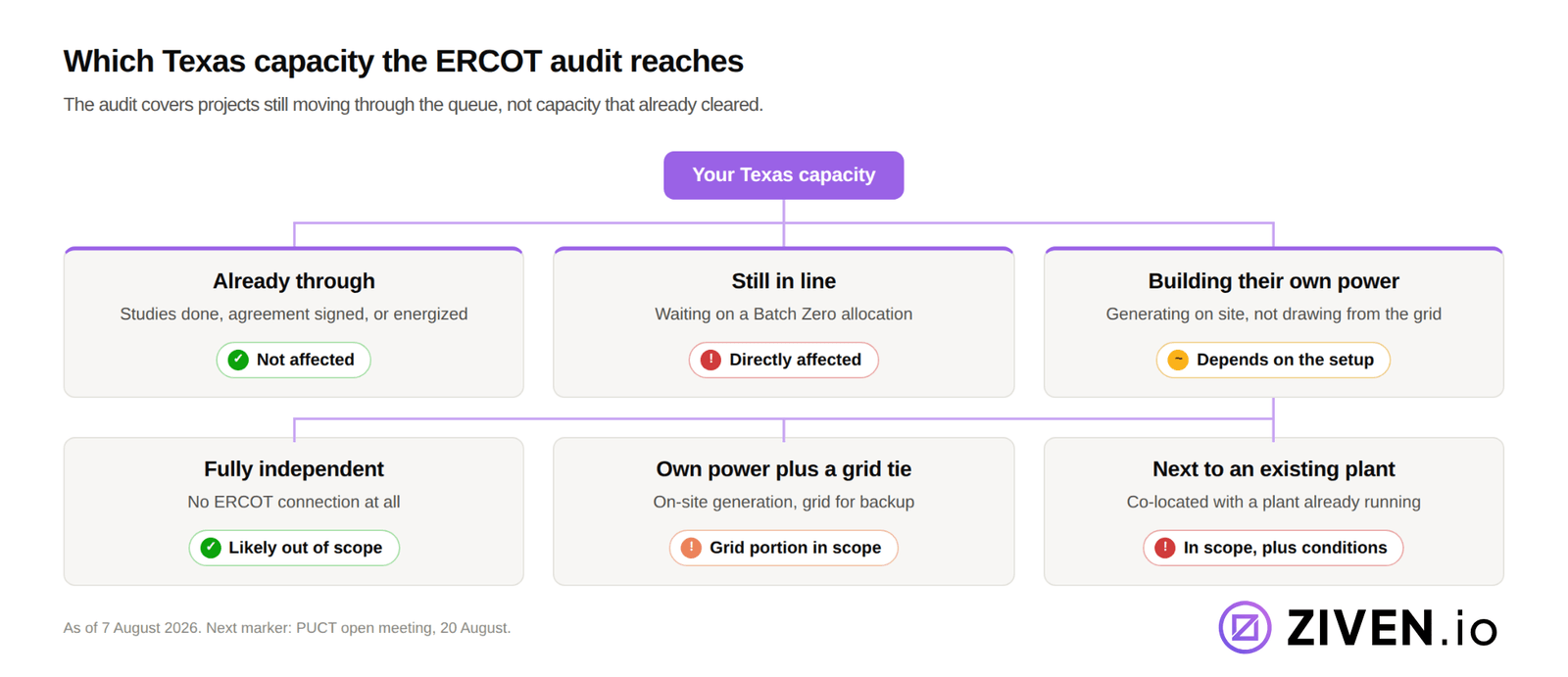
So basically, except for the first category, whether the “build your own power” approach can skip the audit is still unsettled. No state agency has clarified the point. Any “probably exempt” reading circulating today comes from law firms advising developers, not from Texas authorities.
Final Thoughts
My read is that this looks like a delay rather than a lasting shift in how Texas treats data centers. The audit’s stated purpose is to separate real projects from placeholders in the queue. The industry has asked for that filter for a year. NRG’s regulatory team said publicly that the $50,000/MW security “did not have the culling effect that we thought it was going to”.
However, the practical impacts are already visible. Approved capacity has become scarcer, pending allocations have lost clear 2027 visibility and prospective tenants are now more likely to wait.
August 20 is the marker. If the PUCT grants the exception and a new classification date, the episode will look like housekeeping in hindsight. If it grants the exception with no deadline, some developer will likely withdraw from Batch Zero and demand their security deposits back before the end of Q3.
No one knows how long the audit will run. The practical check for any name you hold is simple: look at the public filings and determine whether its next gigawatt is already granted, fully off-grid, or still waiting for approval.