Key Takeaways
- Donalds outlined a Florida bitcoin reserve in his Oct. 17 interview, alongside fractional asset ownership.
- At odds near 80%, Donalds said Polymarket offers daily trends, while ballots ultimately decide elections.
- Looking 10 years ahead, Donalds warned that weak crypto rules would push investment and growth overseas.
Florida congressman and gubernatorial candidate Byron Donalds wants Florida to build a bitcoin reserve, but the people writing the rules for digital assets don’t inspire much confidence in him. In a wide-ranging Oct. 17 interview with Bitcoin.com News, Donalds argued that governments should consider holding bitcoin while questioning whether lawmakers and regulators understand the financial machinery taking shape around them.
The conversation traveled from clients asking about a spare $1,000 to a proposed state reserve, hurricane insurance, and election contracts putting his chances around 80%. Throughout, Donalds returned to a question with consequences well beyond cryptocurrency: Who actually knows enough to call the shots?
From a Spare $1,000 to a Government Reserve
Before politics, Donalds worked in banking, finance, and insurance. His early encounters with bitcoin came through clients who wanted advice on something their financial adviser was still trying to size up himself.
“Most people hadn’t really researched it fully, and even clients would ask me, ‘Hey, what should I do with this stuff? Should I get into it?’” he recalled. “And I would say: If you have a spare thousand dollars and you want to buy a coin, go ahead.” Asked about its future, his answer then was straightforward: “Honestly, I didn’t really know.”
Today, he sees a different proposition. “I think bitcoin probably has more of a commodity feel now, but that being said, it’s obviously been proven to increase substantially in value,” Donalds said. “For the people who got in back in 2014, 2015, it worked out for them in a major way.”
Asked about legislation he introduced to put a strategic bitcoin reserve into federal law, he described bitcoin principally as a hedge. Everyday payments remain part of the picture, but he sees protection against monetary policy as its stronger selling point.
“But I definitely think it has a commodity play, and a hedge against central banking and monetary policy is probably its highest use, which gives it properties similar to gold,” he remarked. The congressman added:
“So in some respects it’s kind of like digital gold.”
Bitcoin.com News asked whether he supported budget-neutral acquisitions beyond bitcoin obtained through seizures. Donalds distinguished law enforcement seizures from deliberately assembling reserves, without laying out a purchase mechanism.
“But I do think trying to find ways for not just the federal government, but state governments, to begin to assemble a strategic reserve is important,” he said. “Governments going forward have to find ways to hedge against interest rate risk and other concerns, and I think this is a way to do that.”
He was less categorical about whether previous federal bitcoin sales were mistakes. He told Bitcoin.com News:
“It’s probably too early to say … You could say now it was a mistake, depending on the valuation they sold it at, but I think it was more about what the decision-making process was at that time.”
Congress Still Has Passbooks on Its Mind
Asked about the stablecoin-focused GENIUS Act and the CLARITY Act crypto market structure bill, Donalds singled out the Senate as the chief obstacle to a workable framework. His diagnosis was blunt, and it extended beyond the lawmakers themselves.
“The issue is that you have a bunch of senators who have no idea what this stuff really is, and their staff don’t know either,” he said. “So there’s a lot of misinformation and a lot of different viewpoints going around Capitol Hill, especially in the United States Senate.”
His remarks came on the heels of last month’s unsuccessful cloture vote, which brought the CLARITY Act’s legislative progress to a standstill. Donalds predicted the House would pass the same legislative package in the next Congress. He argued that some members of both chambers still approach finance through an outdated lens.
“But what we’re starting to see is a handful of members in the Senate, and also in the House, who, for the life of me, still think in terms of passbook savings accounts and balancing their savings ledger, as opposed to what the future of assets looks like,” he said.
He also questioned older lawmakers’ familiarity with cryptocurrency and decentralized finance (DeFi). His verdict on the legislation was measured against that limitation:
“CLARITY is about as good as you can get with the current iteration of Congress. I think you’re probably going to need new leaders who can actually get us there.”
A Florida Reserve, but No Central Bank Digital Currency
Government ownership of bitcoin gets his support. A central bank digital currency (CBDC) gets the opposite answer, driven by his concern about financial surveillance.
“I would never want the government to issue a digital currency where we’re supposed to trust that the government would never peer behind the curtain at the financial transactions of Americans,” Donalds said. “I would never support a central bank digital currency, and I never will.”
He said he would retain Florida’s CBDC prohibition enacted by Ron DeSantis. Donalds also accused opponents of CLARITY of supporting a CBDC. For Florida’s crypto industry, he identified two priorities.
“First of all, we actually have proposals to create a strategic reserve in Florida,” Donalds said. “I also think things around fractional exchanges, being able to have fractional ownership in real-world assets, are something Florida can definitely take a lead on.”
The latter means owning a portion of an asset rather than the whole thing. Donalds said Florida could promote digital assets used for investment and as derivatives tied to real-world property, though he did not outline specific rules or a timetable in the interview.
The Insurance Fight Comes Down to Who Pays
The conversation turned from digital assets to the bills Floridians face at home. In Florida’s gubernatorial contest, Donalds is squaring off against Democrat David Jolly, a former U.S. representative from the Sunshine State.
Asked about Jolly’s emphasis on affordability, property insurance, education, and health care, Donalds concentrated his criticism on insurance. The Jolly campaign features a property insurance proposal that seeks to remove hurricane and wind-related risks from the private insurance market altogether, consolidating that exposure within a single, state-backed catastrophic insurance fund.
Donalds weighed in on the proposal, offering his perspective:
“His insurance plan is a government takeover of wind insurance in Florida, and there are multiple problems with his proposal. The first is he doesn’t have the money to fund it.”
Donalds challenged the proposed funding sources, arguing that taxing insurers’ profits would become problematic if their business shifted to government. He also said tourist development taxes were local revenues totaling about $2 billion, and argued that redirecting them would require a state constitutional amendment.
His larger objection concerned the next hurricane. Donalds argued that removing policyholder assessments would leave the state borrowing heavily to pay claims, with residents eventually picking up the tab through taxes.
“If you’re not going to have the ability to assess policyholders, then the state of Florida will have to go borrow $30 billion in the bond market,” he said. “Think how much that would cost.” He warned that repeated storms would require repeated borrowing and called Jolly’s affordability approach “economic stupidity, not based in reality.”
Donalds offered his own target of reducing insurance bills by 20%. “We keep the tort reform supported by Governor DeSantis. We also make some structural reforms to our insurance market,” he said. “We make permitting automatic after storms, so when the storm leaves, people get an automatic permit to rebuild or rehabilitate their property.”
He disputed the idea that moving wind coverage into government hands would deliver savings of 60% to 70%, arguing that premiums or public borrowing would still finance the risk. He said:
“You end up taxing everybody anyway, and I don’t think that’s smart.”
Donalds Sees More Than an Election Bet
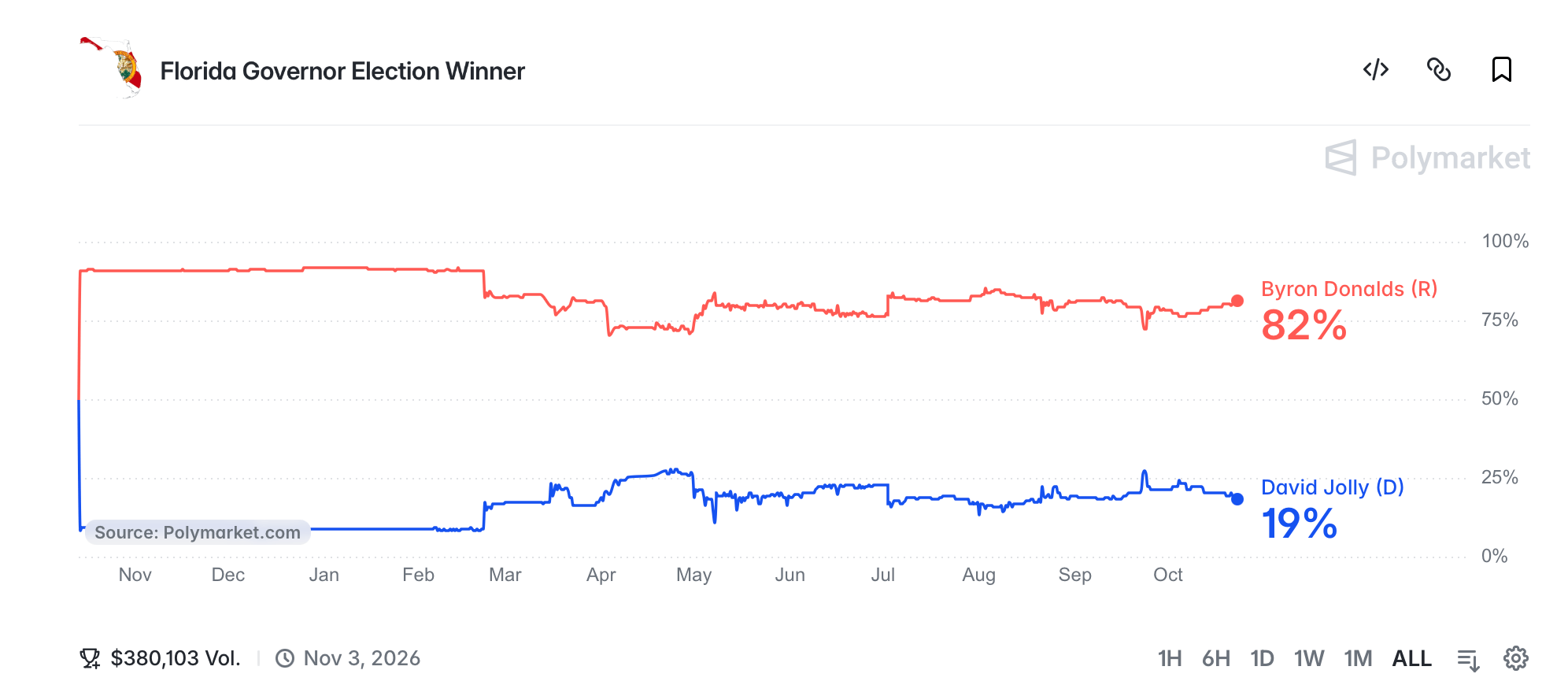
The interview then turned to markets trading on Donalds himself. Bitcoin.com News cited approximately 79% odds on Polymarket and 76% on Kalshi at the time of the conversation. The odds have since increased to 82% as of Oct. 23, 2026.
“I think they give you a better window into daily tracking. Polling just gives you a snapshot in time,” Donalds explained. “What you really want to look at is trend lines, and that’s what prediction markets give you.”
Still, he said ballots mattered more than favorable prices: “But at the end of it all, it’s always going to be about what people are doing. How are they going to show up and vote?” He attributed the market readings partly to what he described as the absence of a major Democratic ballot-return initiative in Florida.
Asked whether these markets were useful or essentially gambling, Donalds drew a distinction between a venue acting as the house and a marketplace matching opposing positions.
“But if you just have a marketplace where people take two sides of an issue, that’s a derivative contract, just like oil futures or orange juice futures or anything else,” he detailed.
He expected the Commodity Futures Trading Commission (CFTC) to prevail in jurisdictional disputes with states. “I largely think the CFTC is probably going to win out, but I could see some state regulatory guidance, probably much more around consumer protection,” Donalds explained.
A 10-Year Warning and a $4 Billion Résumé
Looking a decade ahead, Donalds defined policy failure as development and investment leaving the country because officials couldn’t establish workable rules. He paired his preference for industry growth with a call for basic consumer safeguards.
“I think failure is that a lot of the development in bitcoin, crypto markets, and prediction markets goes offshore, because Congress or the states can’t figure out regulatory systems that allow these industries to grow while making sure the average consumer has baseline protections that are just common sense,” he stressed.
Even a federal framework would leave another question, Donalds said: “Does the CFTC have the manpower and the intellectual capacity to truly regulate these marketplaces? Or do we just have regulations for regulation’s sake with no real ability to enforce them?”
Donalds said he had advocated industry self-regulation, including among Republican colleagues. “Let the industry create a regulatory framework, because whether it’s bitcoin, crypto, prediction markets, or tech overall, it’s moving so fast,” he emphasized. Asked whether he believes government capacity would improve, he answered, “No. Unfortunately, I don’t.”
He argued that the government responds too slowly to supervise these markets in real time. In closing, in terms of leading the state of Florida, Donalds described his campaign as super focused on housing, education, affordability, and government accountability. He pointed to his financial services career as the practical grounding for those ambitions.
“I was licensed. I managed a universal life insurance policy portfolio of about $4 billion,” he said. “At the start of my career, I was a credit analyst at a community bank, underwriting everything from housing starts to planned unit developments to commercial centers.”
He finished with the distinction he wants voters to remember, stating:
“Guiding Florida into the future is going to require a governor who knows economic policy, not just from a legal side, but from a real-world application side.”