Grayscale has estimated that the United States accounts for roughly 15–20% of global crypto activity, arguing that adoption will keep moving forward regardless of the outcome of next week’s midterm elections.
Summary
- Grayscale places the US share of Bitcoin hashrate at 36% and Ethereum full nodes at 31%.
- Payments, trading, and wallet usage show smaller US shares than mining and network infrastructure.
- The estimate draws on 14 indicators with different reporting periods and geographic coverage.
- Cambridge’s mining research provides a separate comparison, with US firms heavily represented in its survey.
Grayscale’s report, published Oct. 28 by research head Zach Pandl, presents the figures as part of its case that crypto’s growth extends beyond American politics. Its accompanying chart brings together measures of infrastructure, transactions, ownership and user activity.
Grayscale finds the largest US shares in Bitcoin and Ethereum infrastructure
Bitcoin mining leads the chart, with the US accounting for an estimated 36% of global hashrate. Ethereum full nodes follow at 31%, while the country’s share of onchain transaction value stands at 26%.
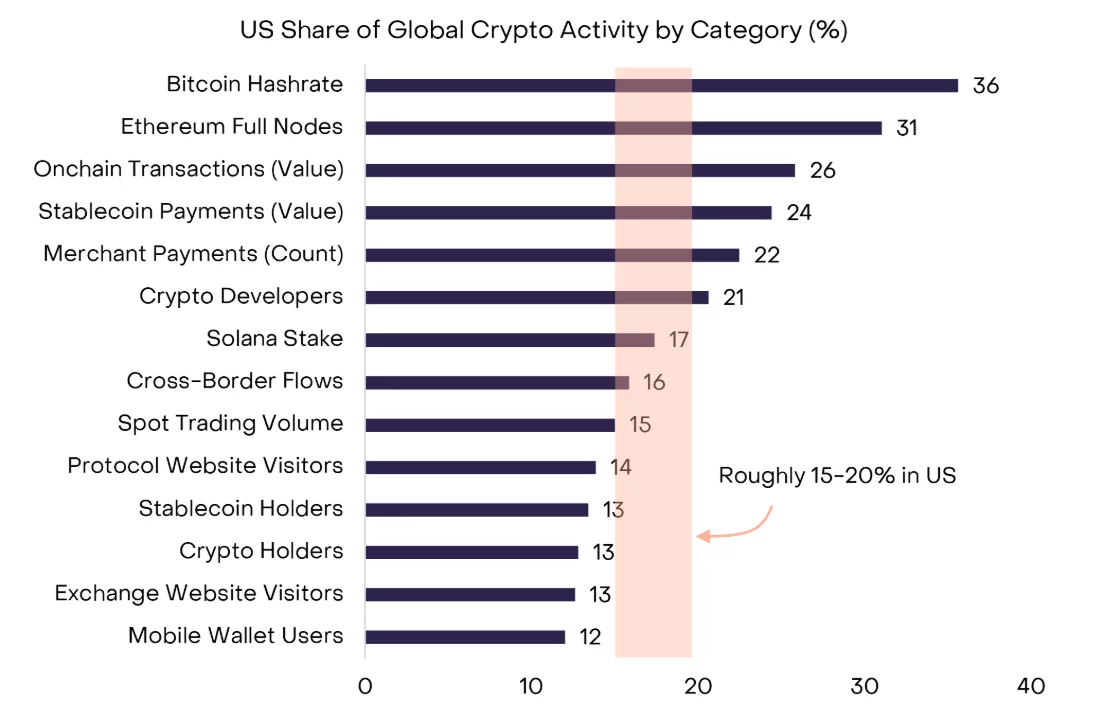
Payment activity falls below those infrastructure figures. The chart assigns the US 24% of stablecoin payment value and 22% of merchant payment transactions, with developers at 21%.
Further down the list, Solana stake comes in at 17%, cross-border flows at 16% and spot trading volume at 15%. Protocol website visitors account for 14%.
The smallest readings concern ownership and access. Crypto holders, stablecoin holders and exchange website visitors each register 13%, while mobile wallet users stand at 12%, according to the chart.
Across the displayed categories, the US share runs from 12% to 36%, a difference of 24 percentage points. Bitcoin hashrate’s share is three times the mobile wallet figure, based on the chart’s rounded readings.
The 15–20% estimate combines different measures
The chart’s footnote explains how Grayscale reached its headline range. Its indicators have a median US share of 16% and a mean of 19%, which the firm uses to support the approximate 15–20% estimate.
The underlying observations cover 2023 through 2026, depending on the indicator, and were assembled as of October 2026. They do not all describe the same reporting period.
Geographic coverage differs, too. Estimates for crypto holders and stablecoin payments cover North America, while the stablecoin-holder figure applies only to Phantom Wallet. Merchant payment counts come from CoinGate alone.
Among the named sources are a16z, Forbes, Triple-A, Phantom, Kaiko, the Bank for International Settlements, Solana, Electric Capital, CoinGate, McKinsey/Artemis, Chainalysis, TRM Labs, the University of Cambridge and Hashrate Index.
Grayscale therefore presents the range as an approximation across several indicators. The chart includes transaction values, payment counts, ownership estimates and infrastructure measures, each with its own stated coverage.
Cambridge’s mining survey measures a different sample
A separate Cambridge study, published in 2025, recorded 75.4% of surveyed mining activity in the United States and 7.1% in Canada.
Its survey covered 49 mining firms with operations in 23 countries. Participants represented approximately 48% of Bitcoin’s network hashrate at the time of data collection.
Cambridge cautioned that strong participation from American firms likely overstated the country’s share. The 75.4% reading describes activity captured by the survey, rather than a finding that the US controlled that proportion of all Bitcoin mining.
The researchers nevertheless identified North America as the main location for surveyed operations, alongside emerging activity in South America and the Middle East and continued mining in Northern Europe.
US crypto policy remains active ahead of the election
In Pandl’s assessment, bipartisan ownership and institutional participation support continued adoption. He cited polling on Republican and Democratic crypto use, bipartisan backing for legislation and financial firms’ work with stablecoins, tokenized funds and exchange-traded products.
Washington’s rulemaking has continued ahead of the vote. As crypto.news previously reported, the OCC finalized rules under the GENIUS Act on Oct. 21, covering reserves, redemptions, risk management and supervision, with a Jan. 18, 2027, effective date.
The Federal Reserve’s separate proposals, released Sept. 24, address reserve backing and applications from insured state member banks seeking to issue stablecoins through subsidiaries.
Market-structure legislation faces a different timetable. Previous midterm coverage recorded a 49-to-50 Senate vote on Sept. 15 against advancing to debate on the CLARITY Act. The vote concerned whether to begin consideration of the bill, not its final passage.