Hong Kong’s Securities and Futures Commission (SFC) has added decentralized derivatives exchange Hyperliquid to its list of suspicious virtual asset trading platforms over concerns that it may be offering services in the jurisdiction without regulatory authorization.
Summary
- Hong Kong’s SFC added Hyperliquid to its suspicious trading platform list on Nov. 18.
- UK and Singapore regulators previously issued public warnings concerning Hyperliquid.
- Hong Kong’s SFC has not announced a website block or trading suspension for Hyperliquid.
- Hyperliquid’s Assistance Fund converts allocated trading fees into HYPE for token burns.
- HYPE price could revisit $60 if selling pressure pushes it below the $65.07 support.
In a Nov. 18 notice, the regulator identified the entity as Hyperliquid / Hyperliquid Hong Kong and listed its official trading interface, app.hyperliquid.xyz/trade, as the website associated with the warning.
The SFC said Hyperliquid was not licensed and was suspected of operating a virtual asset trading platform in Hong Kong or “actively marketing its services to the Hong Kong public.”
Hyperliquid (HYPE) showed a limited price reaction following the publication of the warning, trading at $68.48 during Thursday’s session, down 0.33% over 24 hours. However, the cryptocurrency remained 12.62% lower over the past month.
crypto.news reached out to Hyperliquid for comment but had not received a response by press time.
What does Hong Kong’s SFC warning mean for Hyperliquid users?
Hong Kong introduced its licensing framework for centralized virtual asset trading platforms in June 2023, requiring operators conducting business in the city or actively targeting local investors to obtain regulatory authorization.
Under the SFC’s licensing framework, regulated platforms must comply with requirements covering customer asset custody, operational controls and investor protection.
The commission has previously worked with the Hong Kong Police Force to restrict access to websites associated with suspicious trading platforms. In March 2025, police took steps to block access to Linkbex’s website at the regulator’s request following complaints involving suspected investment fraud.
The latest warning against Hyperliquid, however, contains no announcement of an internet service provider block, app-store removal, asset freeze or mandatory suspension of trading services. It does not specifically accuse the platform of fraud.
Unlike centralized cryptocurrency exchanges, Hyperliquid operates its own blockchain, with trading and settlement taking place on-chain. Its official website serves as an interface through which users interact with the network.
In a May 2026 regulatory filing, Bitwise noted that Hyperliquid’s primary interface excludes users in the United States and individuals subject to applicable sanctions.
Whether Hyperliquid currently imposes equivalent geographical restrictions on Hong Kong residents remains unclear.
Earlier this month, Crypto.com separately announced plans to discontinue consumer app services in Hong Kong from February 2027, while continuing to pursue regulatory approval for its institutional exchange.
Hyperliquid faces regulatory warnings across multiple jurisdictions
Hong Kong is not the first major financial center to issue a public warning concerning Hyperliquid’s regulatory status.
On May 21, Britain’s Financial Conduct Authority (FCA) added Hyperliquid to its warning list, identifying both the Hyper Foundation’s website and the exchange’s trading interface.
The British regulator stated that Hyperliquid “is not authorised by us and may be targeting people in the UK.”
Singapore’s Monetary Authority subsequently included Hyperliquid on its Investor Alert List on June 26, identifying the same websites.
Despite these warnings, financial infrastructure companies have been exploring ways to introduce Hyperliquid-based derivatives within regulated markets.
On Oct. 29, New York Stock Exchange parent Intercontinental Exchange announced a partnership with Trade[XYZ] to develop a regulated perpetual futures market in the United States using Hyperliquid’s infrastructure.
Kraken parent Payward is pursuing a separate proposal to introduce permissioned perpetual futures markets through Bitnomial, with NinjaTrader Clearing responsible for carrying customer accounts.
Both initiatives remain subject to regulatory approval.
Could regulatory restrictions put pressure on HYPE price?
Hyperliquid’s trading activity is directly connected to one of the mechanisms through which its native token is removed from circulation.
According to the protocol’s fee documentation, its Assistance Fund automatically converts allocated trading fees into HYPE, with the acquired tokens permanently removed from the circulating and total supply.
A sustained reduction in trading activity could consequently reduce the amount of fee revenue available for these purchases, although the SFC warning has yet to establish any measurable impact on Hyperliquid’s trading volumes.
Bitwise has previously identified regulatory enforcement, restrictions on the trading interface and declining network activity among the factors that could negatively affect HYPE’s market value.
Hyperliquid price faces resistance near $69
According to the latest HYPE market data, Hyperliquid remained the tenth-largest cryptocurrency, with a market capitalization of approximately $16.25 billion and daily token trading volume exceeding $811 million.
On the daily chart, HYPE continues to form lower highs and lower lows, with the nine-day moving average at $69.38 remaining below the 21-day moving average at $76.12.
The Relative Strength Index stands at 38.04, slightly above its signal average of 36.67 but below the neutral 50 threshold.
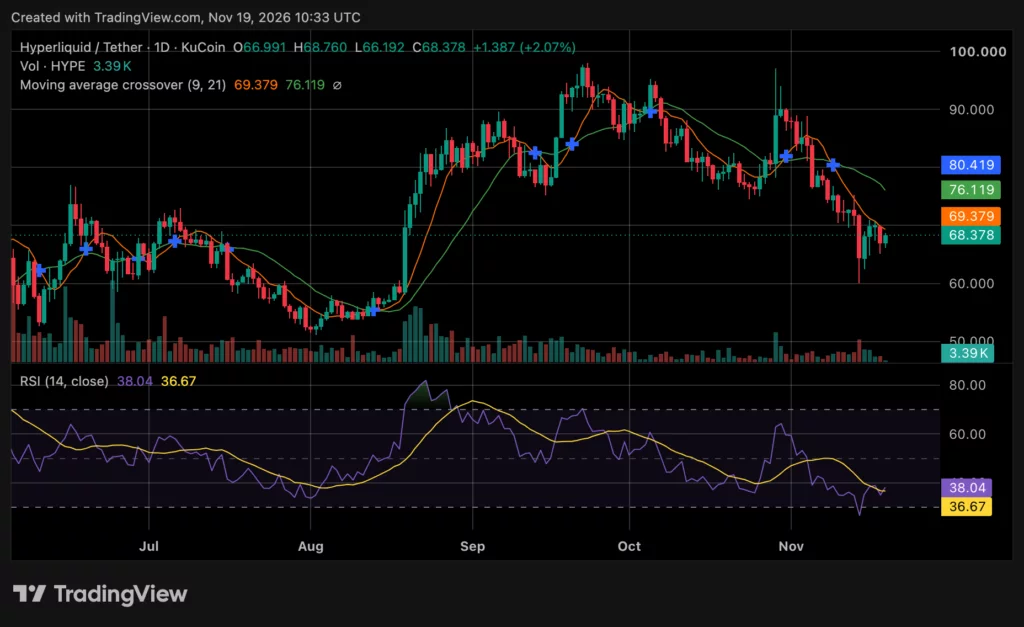
Immediate resistance lies between $69.23 and $69.38, followed by $76.12 and $80.42. On the downside, a break below the recent low of $65.07 could expose the psychological support level at $60, approximately 12% below Thursday’s trading price.
Disclosure: This article does not represent investment advice. The content and materials featured on this page are for educational purposes only.