The Bitcoin-to-silver price ratio is emerging as a key macroeconomic signal, offering insight into shifting risk appetite as capital rotates between digital and traditional hard assets.
Summary
- Falling ratio signals risk-on behavior favoring Bitcoin.
- Rising ratio reflects defensive rotation into silver.
- Ratio provides macro context, not direct trade signals.
As global markets navigate ongoing macro uncertainty, the relationship between Bitcoin and silver prices is drawing increased attention. The Bitcoin–silver price ratio, which measures how many ounces of silver are required to purchase one Bitcoin, provides valuable insight into investor behavior.
Rather than acting as a direct trading signal, the ratio reflects broader risk-on and risk-off dynamics, revealing how capital is positioned across asset classes.
Understanding the Bitcoin–Silver price ratio
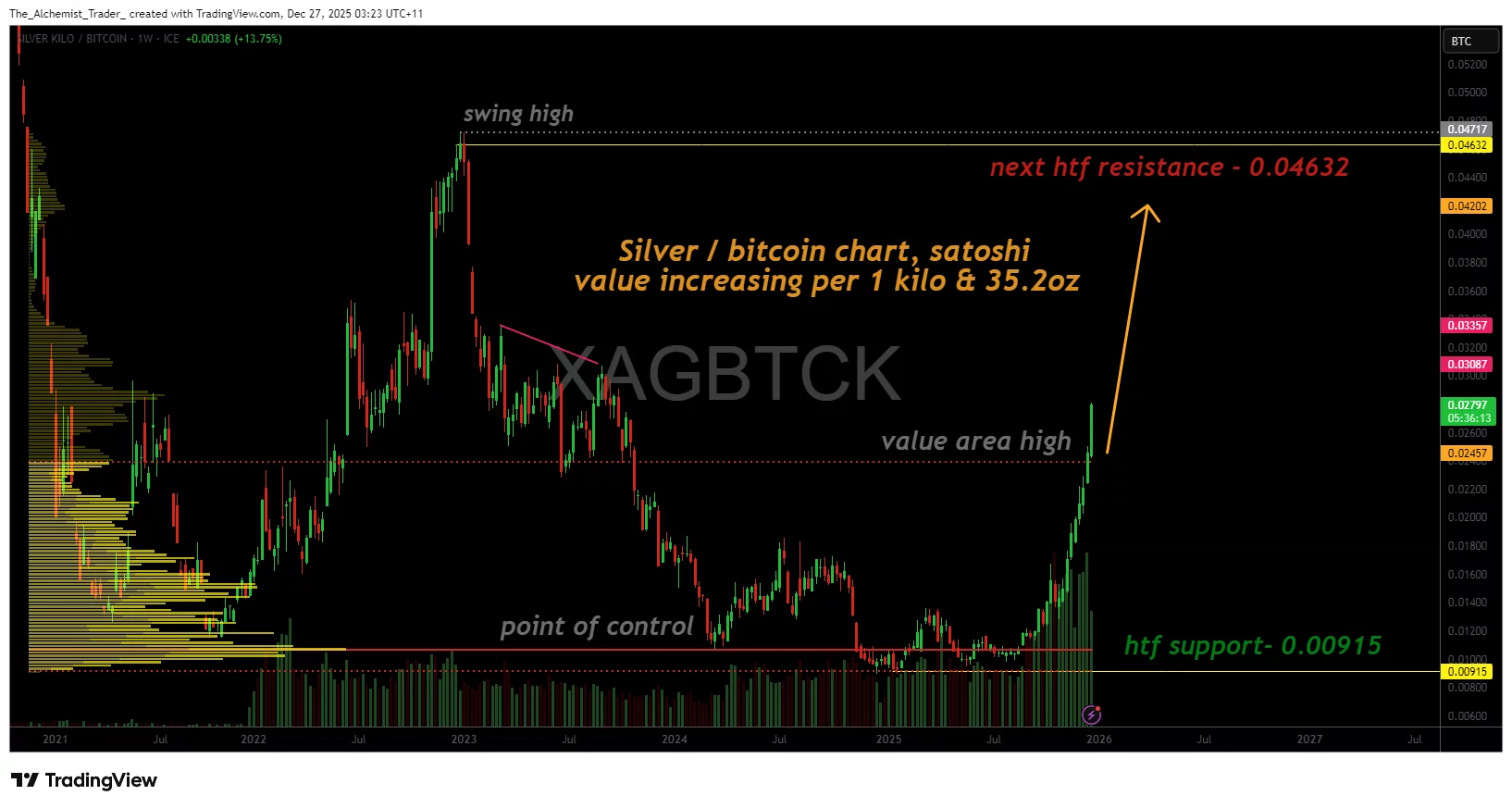
As the price of silver increases, the price of Bitcoin, measured in silver, also rises. This occurs because Bitcoin is often compared to hard assets, such as silver, to assess relative value. When silver becomes more expensive, it takes more value (or purchasing power) for Bitcoin to outperform it.
In other words, even if Bitcoin’s dollar price stays the same, Bitcoin can become more expensive in silver terms when silver rises. This reflects a shift in market dynamics, in which investors are placing greater value on physical assets such as silver.
As silver strengthens, the benchmark for Bitcoin rises as well, implying that Bitcoin must gain further strength merely to maintain its relative position.
Risk-on conditions favor Bitcoin
Periods during which the Bitcoin–silver price ratio declines typically coincide with improving liquidity conditions. During these phases, investors are more willing to allocate capital toward higher-volatility assets, favoring Bitcoin over traditional hard assets.
Historically, declining ratios have coincided with Bitcoin bull phases, during which expanding liquidity and speculative demand drive strong upside momentum. In these environments, silver often underperforms as capital rotates away from defensive hedges and toward growth-oriented assets.
This dynamic reinforces Bitcoin’s role as a liquidity-sensitive asset, responding quickly to shifts in monetary expectations.
Rising ratio signals defensive rotation
Conversely, when the Bitcoin–silver price ratio rises, it indicates that silver outperforms Bitcoin. This typically reflects a risk-off environment, where investors prioritize capital preservation over growth.
Such periods often emerge during macro stress, tightening financial conditions, or heightened uncertainty around inflation and interest rates. Silver’s tangible nature and industrial utility make it more attractive in defensive phases, while Bitcoin’s volatility becomes less appealing.
Importantly, a rising ratio does not necessarily signal bearish conditions for Bitcoin outright. Instead, it often reflects temporary caution, where capital rotates defensively before risk appetite eventually returns.
Mean reversion at extremes
Extreme readings in the Bitcoin–silver price ratio have historically preceded mean reversion. When Bitcoin becomes significantly undervalued relative to silver, it can indicate exhaustion in defensive positioning, setting the stage for renewed inflows into crypto assets.
Likewise, when Bitcoin becomes excessively overextended compared to silver, consolidation or corrective phases often follow as markets rebalance. These extremes are most useful for cycle analysis rather than short-term trading.
Macro liquidity is the primary driver
The Bitcoin-macro liquidity conditions heavily influence the silver price ratio. Silver reacts to real yields, industrial demand, and inflation expectations, while Bitcoin responds more directly to monetary policy, liquidity expansion, and institutional flows.
Divergences in the ratio can therefore serve as early signals of shifts in liquidity regimes, sometimes preceding visible changes in broader risk markets. For this reason, macro-focused traders closely monitor the ratio alongside indicators such as real interest rates, the U.S. dollar index, and Bitcoin dominance.
What the ratio tells investors today
The Bitcoin-silver price ratio highlights the ongoing tug-of-war between digital scarcity and traditional hard assets. While it should not be used in isolation, it provides critical insight into how capital is rotating beneath the surface. The current price rally in Silver indicates a potential more extended consolidation phase in Bitcoin as it is largely seen as a risk-on asset.
In an increasingly interconnected macro environment, understanding this relationship can help investors better navigate shifting market sentiment.