Key Takeaways
- Strategy unveiled new bitcoin metrics July 24, including Net BTC and BTC Hurdle ARR.
- Strategy holds 843,775 BTC bought for $63.69 billion at an average $75,476 per coin.
- BTC Floor ARR now shows the minimum annual bitcoin return needed to sustain Strategy’s 1.0x BTC Rating.
A New Financial Language for Bitcoin
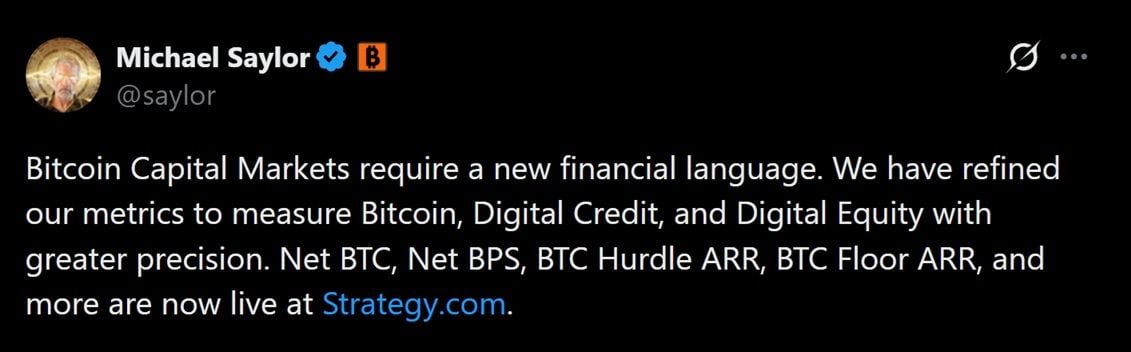
Michael Saylor said, “Bitcoin Capital Markets require a new financial language,” announcing on X that Strategy has “refined our metrics to measure Bitcoin, Digital Credit, and Digital Equity with greater precision.” The new framework went live earlier today, replacing or supplementing several metrics investors have used for years to judge whether Strategy’s bitcoin-buying strategy is creating or destroying shareholder value.
The overhaul comes as Strategy’s capital structure has grown more complex. What was once a simple story, a public company buying and holding bitcoin, now involves multiple classes of preferred stock, a Digital Credit business line, and a growing gap between the company’s market value and the bitcoin backing it. Strategy said the changes “provide a more accurate picture of the Bitcoin value attributable to common shareholders” as Digital Credit becomes a larger share of its balance sheet.
What the New Metrics Actually Measure
The centerpiece is Net BTC Per Share (Net BPS), which shows the bitcoin value attributable to common shareholders after subtracting net debt and preferred equity claims, a rough analogue to book value per share, but denominated in bitcoin rather than dollars. Strategy is also retiring its old mNAV benchmark in favor of comparing share price directly against Net BPS, while keeping 1.0x as the line investors watch for dilution risk.
Two other new figures aim to answer a harder question, i.e. how much bitcoin appreciation does Strategy actually need to keep its debt-fueled strategy sustainable? BTC Hurdle ARR represents the company’s effective funding cost, which is the annualized bitcoin return needed to clear a positive spread over what Strategy pays to service its debt and preferred obligations.
BTC Floor ARR sets a lower bar: the minimum annualized bitcoin return required just to maintain a 1.0x BTC Rating under the company’s current capital structure. Strategy also renamed its former Amplification metric to Bitcoin Equity Multiplier, describing how much the capital structure magnifies common shareholders’ exposure to bitcoin’s price swings, and added simpler market indicators like Premium to 200-week moving average (200WMA) and a Fear & Greed Index to the dashboard.
The new metrics build on ground Strategy has been laying for months. The company’s earlier BTC Breakeven ARR figure, under which Saylor said bitcoin needed just 3.3% annual growth for Strategy to keep funding its STRC preferred dividends indefinitely, was a simpler predecessor to the more granular Hurdle and Floor ARR figures unveiled this week.
The Treasury Behind the Numbers
The metrics exist to explain a treasury that has kept growing even as Strategy’s buying pace has slowed. The company held 843,775 BTC as of its most recent disclosures, acquired for a total cost of $63.69 billion at an average price of $75,476 per coin, including fees.
That haul makes Strategy the largest corporate bitcoin holder by a wide margin, well ahead of SpaceX’s 18,712 BTC treasury, for comparison, which only became public through the rocket company’s own IPO paperwork this year.
Strategy has also grown more selective about buying. The company disclosed on July 6 that it sold 3,588 BTC for roughly $216 million between June 29 and July 5, using the proceeds to fund preferred dividends and rebuild a dollar reserve that stood near $3.2 billion in its most recent update.
It marked one of the rare instances of Strategy trimming its bitcoin position rather than adding to it, a shift that has made some analysts caution against buying MSTR stock even as Saylor insists the company remains singularly focused on bitcoin.
The new metrics won’t change how much bitcoin Strategy owns, but they give shareholders (as well as short sellers) sharper tools to judge whether the company’s leverage is still working in their favor. With BTC Hurdle ARR and BTC Floor ARR now published alongside the Fear & Greed Index on Strategy’s own dashboard, investors no longer have to take Saylor’s confidence on faith; they can watch, in real time, exactly how much bitcoin needs to gain each year to keep the whole structure solvent.