Pi Network Price Today
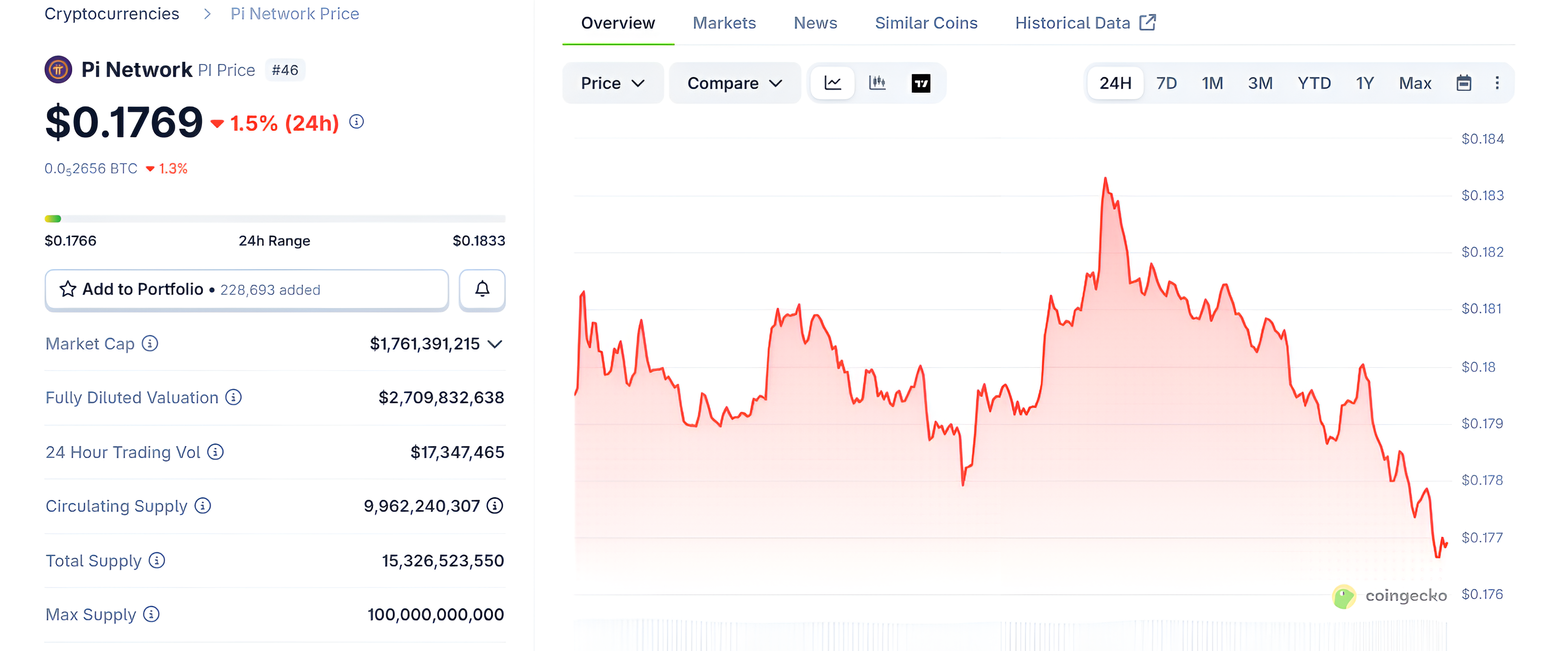
Pi is currently trading at $0.1769, down by 1.5% over the last 24 hours. Its market cap stands at over $1.76B, with a 24-hour trading volume of approximately $17.35M. Ranked 46th among digital currencies, it accounts for 0.074% of the total crypto market capitalization (≈$2.37T).
As Pi Network gradually rolls out second migrations, buying activity has increased, signaling a rise in demand. Users who’ve completed their first migration can move their second transferable Pi balances, including referral mining bonuses, to the mainnet.
Pi Network Price History

Pi coin began trading on crypto exchanges on February 20, 2025. It reached an all-time high (ATH) of $2.99 within six days. Since then, it has been on a sustained downtrend.
| Metric | Price | Date | % Difference from current price |
| All-time high | $2.99 | February 26, 2025 | -94.10% |
| All-time low | $0.1312 | February 11, 2026 | +34.50% |
Pi reached an ATH of $2.99 during early trading phases, driven by initial hype, speculation, and low circulating supply. As more Pi coins entered circulation through mainnet migrations and token releases, the price came under downward pressure. Declining momentum, coupled with sell-offs, further weakened demand, leading Pi to an ATL of $0.1312. Though Pi has recovered by 34.50% from its ATL, it has fallen by 79.80% from its initial trading levels. Overall, Pi continues to experience low adoption, and, therefore, its prospects remain uncertain.
What Is Pi Network (PI)?
Pi Network is a mobile-first, energy-efficient blockchain that enables users to mine Pi coins using smartphones. Its mobile mining process is simple and meritocratic, eliminating the need for specialized equipment and computationally-intensive calculations. Pi Network aims to make cryptocurrency mining accessible to all and build a community-driven decentralized ecosystem with real-world applications. It follows the Federated Byzantine Agreement framework and the Stellar Consensus Protocol to validate transactions.
What Problems Does Pi Network Solve?
- Reduces energy consumption: Traditional mining is energy-intensive, consuming lots of computational power and electricity. Pi mining is energy-saving, allowing you to earn Pi by tapping a button every 24 hours and performing basic tasks.
- Fosters inclusion: Pi mining is free and doesn’t require users to make large upfront investments in setting up mining rigs. Anybody with a mobile device can mine Pi.
- Ensures decentralization: By nurturing security circles and a trust-based community of pioneers, the project aims to promote decentralization. Its KYC process helps ensure only real users, not bots or bad actors, participate in securing the distributed network.
- Boosts crypto adoption: Extreme volatility, high mining costs, and inherent complexities have limited mass adoption of crypto assets. Pi app’s beginner-friendly interface makes it easier for users without technical knowledge to mine Pi.
What Makes Pi Network Unique?
It is the first cryptocurrency that can be mined on a smartphone for free through an energy-light mobile application. It aims to attract daily users rather than just technology or crypto enthusiasts. Moreover, its robust KYC process minimizes fake accounts, fostering a reliable ecosystem. In essence, Pi Network could be potentially profitable if mainstream adoption increases, driving ecosystem growth and market demand.
Pi Tokenomics and Supply
| Current market cap | $1,761,391,215 (≈1.76B) |
| Current Circulating Supply | 9,962,240,307 (≈ 9.96B) |
| Total supply | 15,326,523,550 (≈ 15.33B) |
| Maximum supply | 100B |
Is Pi Network Legitimate?
While Pi Network isn’t considered a scam, it remains in an experimental phase with no proven real-world usability. Its long-term growth and legitimacy depend on its ability to deliver valuable use cases and attain widespread adoption. Besides, the network isn’t truly decentralized, as the core team makes key decisions and controls 20 billion Pi coins. There is also no clarity on the exact number of validator nodes in the network. Additionally, mainnet access is restricted to KYC-verified users, making Pi Network a speculative, high-risk, and unproven project.
Pi Network Project Development
- Phase 1 (Launch): On March 14, 2019, Pi Network released its official white paper. During this phase, the network focused on attracting users, expanding global reach, and building a trust graph. The Pi mobile application enabled users to mine Pi without a live blockchain using smartphones.
- Phase 2 (Testnet): On March 14, 2020, Pi Network launched a live Testnet with globally distributed nodes. It built key ecosystem components, including Brainstorm, Browser, developer tools, and Wallet. The Pi Browser app included a pilot version of its KYC process. This phase helped improve the network’s consensus mechanism, security, and scalability.
- Phase 3 (Mainnet): The Pi blockchain mainnet went live in December 2021. It allowed KYC-verified users to migrate mined Pi tokens to the mainnet. The enclosed network period continued until February 2025, limiting external connectivity. As of March 2026, the open network phase is underway.
FAQs
Pi coin is the Pi blockchain’s native token that has been migrated to the mainnet from the Pi app’s testnet.
Nicolas Kokkalis and Chengdiao Fan founded Pi Network in 2019. Both hold Stanford University PhDs in computer science and anthropological science, respectively.
The Pi token facilitates borderless payments and P2P transfers. It also powers transactions, smart contracts, decentralized applications, and marketplace integrations within the Pi ecosystem.
You can buy Pi on supported centralized exchanges like MEXC and Bitget. You can also mine Pi in the Pi app, provided you receive an invitation from a trusted member and pass KYC.