SLX exploded onto Korean exchanges, spiked to $0.47, then gave most of it back. Behind the volatility sits a Solana yield protocol with real total value locked. Here is the bull case, the bear case, and where SLX could go next.
Summary
- Solstice is a Solana-native yield protocol built around institutional-style strategies and its own USX stablecoin, and SLX is its governance and utility token, launched in early 2026.
- SLX drew heavy attention through rapid listings on major exchanges including Upbit and Bithumb, spiking to an all-time high near $0.47 before pulling back sharply into the high-teens to low-thirties cents.
- The bull case rests on genuine total value locked, deep exchange liquidity, Solana ecosystem momentum, and a fixed token supply, which set Solstice apart from purely speculative launches.
- The bear case centers on vesting-driven sell pressure, the token’s short and unproven history, extreme volatility, and its exposure to Solana and the broader risk-off market.
- The realistic path for SLX is wide: a reclaim toward $0.47 is possible if total value locked keeps growing, while a break of key support near $0.20 would open the door to launch-era lows.
Solstice and its SLX token became one of the few things moving in a bruised crypto market, spiking more than 50% in a single day at one point and drawing intense trading volume across Korean and global exchanges.
Behind the price action is a Solana-based yield protocol that, unlike many recent launches, arrived with a working product and real capital already flowing through it. That combination of genuine fundamentals and violent volatility is exactly what makes SLX interesting and hard to forecast.
This price prediction walks through what Solstice is, why SLX is trending, the strongest arguments on both sides, the technical picture, and a set of bull, base, and bear scenarios. None of it is financial advice, and SLX is a small, volatile asset, so the ranges here are wide by necessity.
What is Solstice, and why is SLX trending?
Solstice is a decentralized finance protocol built on Solana that positions itself as a yield layer, bringing institutional-style strategies on-chain instead of chasing meme-driven hype. Its approach centers on strategies such as delta-neutral funding trades and tokenized credit exposure, the kind of yield generation that has traditionally lived outside public blockchains.
At the center sits USX, the protocol’s native stablecoin, which supports lending, yield, and capital-efficient strategies across the Solana ecosystem. SLX is the governance and utility token that powers all of this, and a staked version, stSLX, is already live through integrations such as Exponent Finance.
What separates Solstice from the long tail of small-cap launches is that it came to market with a real product and real capital. The protocol reported total value locked in the hundreds of millions of dollars around its 2026 launch, with staking infrastructure securing over $1 billion in validator operations. That is a genuine fundamental backdrop, not a promise, and it is the main reason serious traders have paid attention instead of dismissing SLX as another listing pump. The token also has a fixed supply, which matters for any long-term valuation argument.
The trending began with distribution. SLX listed rapidly across major venues, with Upbit adding a Korean won pair and Bithumb, OKX, Bybit, Kraken, Gate, and others following within days, plus futures markets on several large exchanges. That breadth of liquidity, combined with strong Korean retail demand, produced enormous volume and sharp moves, including a spike to an all-time high near $0.47 and a later single-day surge of more than 50% on hundreds of millions of dollars in volume.
The token has since pulled back well off that high, which sets up the central question: was the spike a first taste of price discovery for a real protocol, or a listing-driven pump that is now fading?
The bull case for SLX
The bull case starts with the product being real. Solstice is not a whitepaper promise; it is a protocol with meaningful total value locked and a functioning stablecoin in USX, generating the kind of on-chain activity that can support a token’s value beyond speculation. In a market crowded with launches that have no users and no revenue, a Solana yield protocol with hundreds of millions of dollars locked and over $1 billion in secured validator operations stands out. If that total value locked keeps growing, it provides a fundamental floor under SLX that pure momentum tokens lack.
The second pillar is liquidity and reach. SLX is not stranded on one exchange; it trades across Upbit, Bithumb, OKX, Bybit, Kraken, and more, with active futures markets. That multi-exchange presence, and the strong Korean demand that has driven much of the volume, means SLX can attract capital from many directions and can move fast when sentiment turns positive. Deep, distributed liquidity is a real asset for a young token, because it lowers the friction for new buyers and supports larger positions without extreme slippage.
The third pillar is the Solana ecosystem itself. Solstice is a bet on Solana, and Solana has its own momentum, with major protocol upgrades in progress and spot Solana exchange-traded funds already drawing inflows even during the downturn. If Solana strengthens, its native yield protocols benefit from rising activity and capital, and SLX is positioned squarely in that flow as an institutional-yield and stablecoin play. Add a fixed token supply and a live staking mechanism through stSLX, and the bull case is that SLX is an early-stage bet on real Solana yield infrastructure, with room to reprice higher if adoption compounds and the market rotates back toward risk.
The bear case for SLX
The bear case is equally concrete, and it starts with sell pressure baked into the token’s design. Solstice used vesting mechanics tied to its early reward programs, and those mechanics have created real, forced selling. Users who chose vesting options faced deadlines and requirements to maintain total value locked or risk losing unclaimed tokens, which forces decisions that ripple through the market in short, sharp bursts. When early participants are pushed to claim, sell, or restructure positions on a schedule, that overhang weighs on price regardless of how good the underlying protocol is.
The second problem is that SLX is new and unproven over any meaningful time horizon. It launched in 2026, so it has no track record across a full market cycle, no history of how its yield strategies perform under stress, and no evidence yet that its total value locked is sticky rather than mercenary capital chasing incentives. Delta-neutral and tokenized-credit strategies carry their own risks, and a young protocol has not been tested by a genuine crisis. Small market capitalization compounds this: a token this size can move violently in both directions, and the same volatility that produced a 50% up-day can produce equally brutal declines.
The third pressure is external. As a small-cap token, SLX is highly sensitive to the broader market, and small caps are typically hit first and hardest when risk appetite fades. The wider crypto market entered the second half of 2026 off its worst month on record, with macro headwinds from a hawkish Federal Reserve and tight liquidity, and in that environment speculative Solana tokens are vulnerable. SLX also depends heavily on Solana; any weakness in the ecosystem, or a rotation away from it, pulls SLX down with it. The bear case is that the listing-driven spike was the peak of attention, and that vesting overhang plus a hostile macro backdrop grinds the token back toward its launch-era lows.
The technical picture
The chart tells a story of a sharp discovery phase followed by a deep retracement. SLX reached an all-time high near $0.47 in its early weeks, driven by listing momentum and Korean demand, then fell hard as that initial euphoria faded and vesting pressure kicked in.
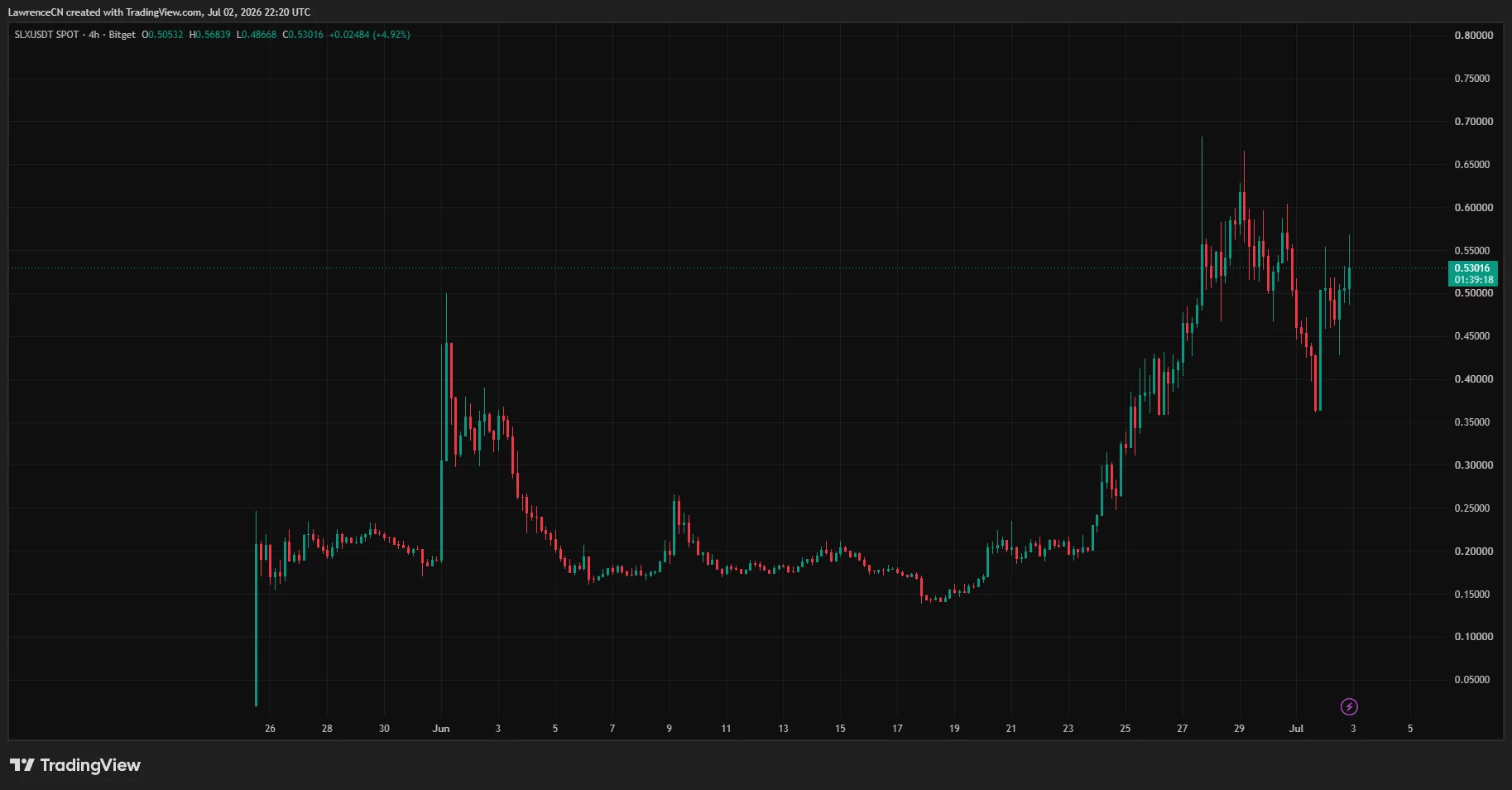
Along the way, it printed dramatic moves, including a single-day surge of more than 50% to around $0.26 on roughly $253 million in volume, the kind of volatility that defines a young, thinly seasoned token in active price discovery. Since the high, the token has traded well below it, at times slipping into the high teens in cents.
The key level bulls and bears are watching is support around $0.20. That zone has acted as a line in the sand: holding it keeps a recovery structure intact, while a decisive break below it signals that the earlier bounce was just a bounce and opens the path toward launch-era lows. On the upside, the token has to reclaim and hold higher ranges before the $0.47 all-time high comes back into view, and doing so would require sustained volume and improving sentiment rather than a single spike. Momentum indicators have swung with the price, reflecting a token that has not yet settled into a stable trend.
The honest read of the technicals is that SLX is in an unresolved range beneath its all-time high, with $0.20 as the pivotal support and the high near $0.47 as the reference resistance. Because the token is young and volatile, technical levels are less reliable than they are for seasoned assets, and a single macro or protocol catalyst can override the chart.
For a price prediction, the technicals mostly define the boundaries: a wide zone between the low-twenties cents on the downside and the high-forties on the upside, with the resolution depending on fundamentals and market conditions more than on any pattern.
What could move SLX next
Several specific catalysts will likely decide which way SLX breaks. The most important is total value locked. Because Solstice’s entire investment thesis rests on being a real yield protocol, the trajectory of its total value locked is the single best signal to watch.
Growing total value locked, especially if it proves sticky after incentive programs wind down, would validate the fundamental case and support a higher token price. Shrinking total value locked, or evidence that the capital was purely mercenary, would undercut the whole argument. Adoption of the USX stablecoin is part of the same story, since real usage of USX in lending and yield is what turns Solstice from a launch into a lasting protocol.
The second driver is the vesting and unlock schedule. Because forced selling from vesting has already pressured the token, the timing and size of upcoming unlocks matter directly. Periods of heavy unlocking are headwinds; periods where supply pressure eases give the token room to recover. Traders watching SLX should track the schedule closely, because unlocks are among the most predictable sources of selling for a young token.
The third set of catalysts is external: Solana and the macro backdrop. Strength in Solana, whether from protocol upgrades, exchange-traded-fund inflows, or a broad rotation back into the ecosystem, would lift SLX, while Solana weakness would drag it down. Above that sits the overall market, where macro signals like inflation data and Federal Reserve policy set the risk appetite that small caps live and die on.
Continued Korean exchange demand is a further wildcard, since that flow has driven much of SLX’s volume and could reignite momentum or fade. The interplay of protocol growth, unlock pressure, Solana health, and macro risk appetite is what will move SLX from here.
Is SLX a trade or a long-term hold?
One of the most useful ways to think about SLX is to separate the short-term trade from the long-term thesis, because they are governed by very different forces. As a short-term trade, SLX is a momentum and liquidity story. Its price has been driven by listing events, Korean exchange demand, volume spikes, and vesting-related selling, and those forces produce sharp, fast moves in both directions.
A trader focused on this timeframe cares about volume, the $0.20 support, unlock dates, and shifts in market risk appetite, and treats the token as a high-volatility instrument to be sized small and managed tightly. On this horizon, fundamentals matter less than flows, and the biggest risk is being caught on the wrong side of an unlock or a broad risk-off move.
As a long-term hold, SLX is a bet on Solstice becoming durable Solana infrastructure. That thesis rests on whether the protocol’s total value locked proves sticky after incentives fade, whether USX earns real adoption as a stablecoin, and whether Solstice’s institutional-yield strategies keep working across market conditions.
A long-term holder is effectively wagering that a real yield protocol with genuine capital will grow into and beyond its current valuation as Solana matures, and is willing to sit through severe volatility to get there. On this horizon, the daily chart matters far less than the trajectory of the fundamentals.
The two views can point in opposite directions at the same moment. A token can look dangerous as a short-term trade, with unlocks looming and momentum fading, while looking attractive as a long-term accumulation if you believe in the protocol, or the reverse, with strong short-term momentum masking a fragile long-term case.
This is why a single price target is misleading for an asset like SLX: the right answer depends on whether you are trading the flows or investing in the protocol. Being honest with yourself about which one you are doing is the most important risk decision, more important than any level on the chart.
For most people, the practical takeaway is to match position size and time horizon to conviction. If the interest is the trade, keep positions small, respect the levels, and watch the unlock schedule and macro closely. If the interest is the long-term protocol thesis, the questions that matter are about total value locked, USX adoption, and Solana’s health over quarters and years, not about this week’s candle. Blurring the two, holding a trade that went wrong as if it were a long-term investment, or trading in and out of a position meant to be a multi-quarter thesis, is how small-cap tokens do the most damage to a portfolio.
Solstice price prediction scenarios
Because SLX is a young token with limited price history, the most honest approach is to frame scenarios instead of pretending precision. The ranges below are illustrative and built from the drivers discussed above, not guarantees. SLX can move well outside them if the market or Solana shifts suddenly.
Bull case
In the bull scenario, Solstice proves that its total value locked is durable rather than incentive-driven, USX adoption keeps expanding, and Solana remains one of the strongest ecosystems in crypto. Vesting-related sell pressure fades, Korean demand stays healthy, and broader market sentiment improves as liquidity returns to crypto. Under those conditions, SLX reclaims the higher trading ranges, breaks back through resistance, and retests the all-time high near $0.47. If protocol growth continues beyond expectations, price discovery above that level becomes possible, supported by a fixed token supply and expanding usage instead of listing hype alone.
Base case
In the base scenario, the protocol continues growing but at a slower pace than the market hoped. Total value locked remains stable, USX adoption gradually improves, and vesting pressure offsets much of the organic demand. Solana performs reasonably well without entering another major bull phase, leaving SLX trading inside a broad range between roughly $0.20 support and the low-$0.30s. This is the “working protocol, patient market” outcome where fundamentals improve faster than price.
Bear case
In the bear scenario, total value locked begins falling as incentive capital leaves, unlock-related selling continues weighing on the token, and Solana weakens alongside the broader crypto market. The $0.20 support fails, sending SLX back toward launch-era lows as speculative interest fades. Because the token is still early in its life cycle, confidence could deteriorate quickly if growth slows or the macro backdrop remains hostile. This outcome does not require the protocol to fail; it only requires demand to remain weaker than the ongoing supply pressure.
Frequently Asked Questions
What is Solstice (SLX)?
Solstice is a decentralized finance protocol built on Solana that focuses on institutional-style yield strategies. It combines products such as delta-neutral strategies, tokenized credit exposure, and its USX stablecoin to create capital-efficient yield opportunities. SLX is the protocol’s governance and utility token, while stSLX represents the staked version used within the ecosystem.
Why is SLX trending?
SLX gained attention after listing on major exchanges including Upbit, Bithumb, OKX, Bybit, Kraken, and others in quick succession. Strong Korean trading activity, high volume, and a rapid move toward an all-time high near $0.47 pushed the token into the spotlight. Unlike many new launches, Solstice also arrived with meaningful total value locked, giving traders a real protocol to evaluate instead of only speculation.
Can SLX return to $0.47?
A move back to the all-time high is possible but depends on several conditions. Solstice would need to continue growing its total value locked, expand USX adoption, reduce the impact of vesting-related selling, and benefit from a stronger Solana ecosystem and broader crypto recovery. Without those factors aligning, the token could remain below its previous peak for an extended period.
What are the biggest risks for SLX?
The largest risks include vesting-related sell pressure, the protocol’s limited operating history, heavy dependence on Solana, and overall crypto market weakness. Because SLX is a relatively small-cap asset, it can experience much larger swings than established cryptocurrencies, making volatility an important consideration.
Why does total value locked matter?
Total value locked measures how much capital users have committed to the protocol. Rising total value locked suggests growing adoption and confidence, while falling total value locked can indicate users are withdrawing funds or incentives are no longer attracting capital. For Solstice, it is one of the most important indicators of whether the protocol is building lasting value.
Is SLX a long-term investment or a short-term trade?
It can be either, depending on the strategy. Short-term traders generally focus on exchange flows, unlock schedules, volume, and technical levels such as the $0.20 support. Longer-term investors are betting on Solstice becoming important infrastructure within the Solana ecosystem through sustained growth in total value locked, USX adoption, and institutional-style yield products.
What levels should traders watch?
Support around $0.20 remains the key downside level. Holding above it keeps the recovery structure alive, while losing it could send the token back toward launch-era prices. On the upside, reclaiming the low-$0.30 range would improve momentum, with the all-time high near $0.47 remaining the major resistance level.
What could drive SLX higher?
The strongest catalysts would be continued growth in total value locked, broader adoption of the USX stablecoin, easing vesting pressure, stronger activity across the Solana ecosystem, and improving macro conditions that bring capital back into higher-risk crypto assets.
Disclaimer: This article is for informational and educational purposes only and does not constitute financial, investment, or trading advice. Cryptocurrency prices are highly volatile, and forecasts are speculative rather than guaranteed. Nothing in this article should be considered a recommendation to buy or sell any asset. Always conduct your own research and consult a qualified financial professional before making investment decisions. Information is accurate as of July 2, 2026, and may change.