Disclosure: This article does not represent investment advice. The content and materials featured on this page are for educational purposes only.
Bitcoin mining and AI services both depend on electricity and computing equipment, but their revenue comes from different sources. Through power plans, 51AIpower allows individuals to support the electricity and GPU computing required by AI factories without owning hardware.
For anyone considering Bitcoin mining, the first questions are often practical: How much does the equipment cost? What will the electricity bill be? Can the machines run reliably? For individuals who do not want to purchase and maintain hardware, these questions also point toward another area worth understanding: how electricity and computing equipment support the digital economy beyond cryptocurrency networks.
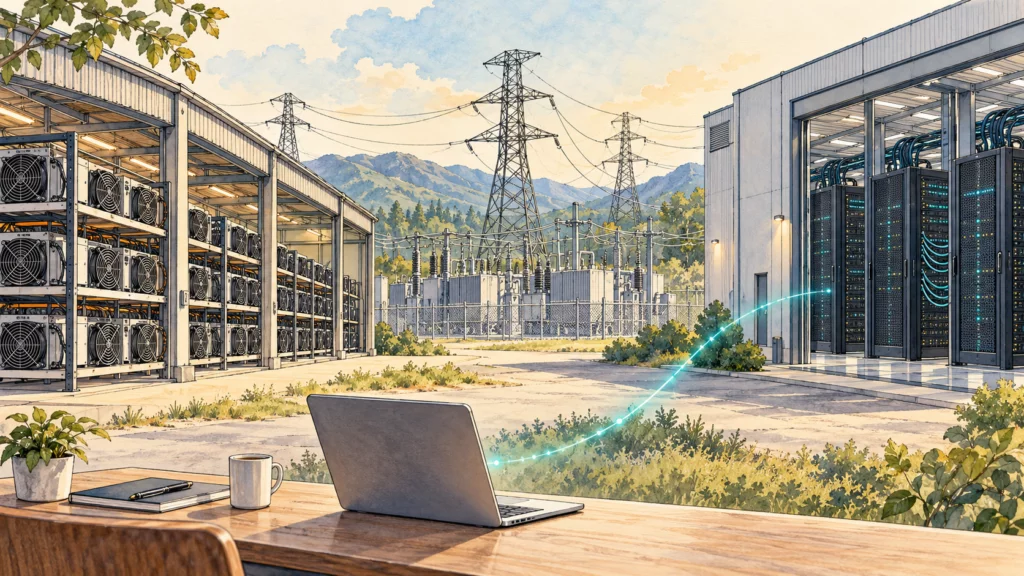
51AIpower focuses on AI infrastructure participation. Through its Power Plans, users support the electricity and GPU computing required by AI factories without buying equipment, installing machines, or supplying their own power. Rewards depend on plan terms and actual operating performance. New users can also access up to 200 free Starter Plan uses, limited to one per day, to explore the process before deciding whether to purchase paid plans.
For readers familiar with Bitcoin mining, the starting point is recognizable: electricity powers equipment, and equipment performs computing tasks. The important difference is whom those tasks serve and where the revenue comes from.
Bitcoin mining vs. AI compute: Where does the revenue come from?
Bitcoin miners perform specialized computing work to compete for the opportunity to add a block of transactions to the blockchain, helping secure the network. A miner that successfully produces a valid block can receive the block subsidy and associated transaction fees. Miners participating in pools share proceeds according to the pool’s rules. Bitcoin.org identifies newly issued bitcoin and transaction fees as sources of mining income.
AI computing services address a different need. When someone asks AI to analyze a document, write code, or answer a customer’s question, a model needs computing resources to complete the task. Businesses providing these services can charge for model usage, subscriptions, or rented computing capacity while covering hardware, electricity, and other operating costs.
The simplest way to understand the distinction is to look at the work being performed. Bitcoin mining supports a blockchain network, while AI computing supports models and applications. Both require cost control, but they generate revenue through different mechanisms.
| Comparison | Bitcoin mining | AI computing services |
| Main task | Perform proof-of-work calculations and compete to produce blocks | Run models for training or inference |
| Main revenue sources | Block subsidies and transaction fees | Customer payments for computing or AI services |
| Typical core equipment | Specialized ASIC miners | GPUs and other computing hardware |
| Key operating considerations | Bitcoin price, mining difficulty, electricity costs, and equipment efficiency | Customer demand, equipment utilization, service pricing, and operating costs |
The hardware is not interchangeable. An ASIC miner designed for Bitcoin mining cannot simply become a GPU server running large AI models. Even where a facility has suitable power access, deploying AI services requires compatible computing, networking, storage, and cooling infrastructure.
AI tokens are not another coin being mined
In AI, tokens generally represent units of content processed by a model. For text models, a token may be a word, part of a word, or a punctuation mark. Both the input a model reads and the response it generates can be measured in tokens.
For example, a company connecting AI to its customer support system triggers model processing whenever a customer submits a question. Token usage varies with the number of questions and the length of the inputs and responses. Many AI APIs use input and output token counts as part of their billing structure.
These tokens are different from cryptocurrency tokens. They are generally not assets that users hold and trade on an exchange, nor are they coins automatically awarded for running equipment. They measure model usage, which involves actual computing work.
In its discussions of AI inference economics, NVIDIA focuses on metrics such as tokens processed per unit of power and the cost of delivering those tokens. These measures help operators assess efficiency, but producing more tokens does not automatically mean earning more profit. Customer demand, pricing, and costs also matter.
How does 51AIpower enable participation without buying GPUs?
For individuals operating a GPU computing service directly, buying equipment is only the beginning. They also need to arrange power and cooling, install software, maintain the hardware, and find customers willing to pay for computing resources. Some costs continue even when equipment is idle.
51AIpower offers participation through platform plans. Users select Power Plans that support the electricity and GPU computing needed to operate AI factories. They do not need to install servers at home or handle daily hardware maintenance.
Under the platform’s stated plan model, rewards are calculated using the electricity contribution and corresponding token output recorded under the applicable plan, with settlement reflecting actual operating performance. Users can view plan status and reward records through their accounts. Calculation methods, durations, and the treatment of funds are governed by the selected plan’s terms.
“No hardware required” reduces the need to operate and maintain equipment; it does not eliminate risk. Participants still need to understand the platform’s responsibilities, how rewards are calculated, and what restrictions apply during a plan’s term.
Beyond electricity costs: Is the equipment doing paid work?
Bitcoin mining has made many people aware that electricity prices and equipment efficiency affect operating results. AI computing involves those considerations too, alongside another direct question: Is the equipment processing tasks that customers are willing to pay for?
Even powerful GPUs may generate disappointing revenue if demand is insufficient or the equipment frequently sits idle. Scheduling tasks effectively, improving utilization, and completing work within customers’ required response times help support an ongoing service business.
NVIDIA identifies token throughput, output per unit of power, cost per token, utilization, and uptime as important measures of AI factory economics. The value of AI infrastructure therefore depends not only on how many machines an operator owns, but also on how those machines are used.
For individuals participating through 51AIpower, industry demand is only part of the picture. More specific questions concern the resources a plan supports, the clarity of its settlement rules, and how changes in operating results are handled. Growth across the AI industry alone does not establish that a particular plan will be profitable.
How can new users access 200 free starter plan uses?
51AIpower offers new users up to 200 free Starter Plan uses, limited to one per day. After registering and verifying their email address, users can sign in, review the plan details, and use their daily free allowance to activate a plan. They can then explore account records and the reward settlement process.
Earnings generated through the Starter Plan are real and credited to the user’s account. However, the 200-use allowance represents opportunities to use the plan for free. It is not $200 in cash and cannot be exchanged all at once for a withdrawal balance. Withdrawals remain subject to the platform’s conditions.
After trying the process, users can decide whether to purchase paid Power Plans. Before doing so, they should review plan durations, reward calculations, early termination rules, and withdrawal requirements. A free trial can help explain how the platform works, but it does not establish that future paid plans will be profitable.
Understanding a computing business beyond Bitcoin mining
Bitcoin mining and AI computing both use electricity and equipment to support digital services, but their revenue models differ. Bitcoin mining centers on block rewards and transaction fees, while AI computing serves customer demand for models and computing services.
51AIpower uses power plans as an entry point for individual participation in AI infrastructure, allowing users to explore the model without owning GPUs. For those considering opportunities beyond mining, the first step is to understand what they are supporting, how rewards are determined, and which risks they would assume.
Risk Disclosure: AI infrastructure participation plans involve risks relating to platform performance, equipment operations, energy costs, and market demand. Returns are not guaranteed, and participants may lose money. A free trial does not establish that paid plans will be profitable. Plan durations, withdrawal conditions, and other restrictions are subject to platform terms. This article is promotional content for 51AIpower and does not constitute investment advice.
About 51AIpower
51AIpower is an AI infrastructure participation platform operated by Power Cloud Solutions Ltd. Through power plans, individuals support the electricity and GPU computing required by AI factories and receive rewards subject to plan terms and actual operating performance.
Website: https://51aipower.com
Contact: [email protected]
Disclosure: This content is provided by a third party. Neither crypto.news nor the author of this article endorses any product mentioned on this page. Users should conduct their own research before taking any action related to the company.