Key Takeaways
- Gold reached 27% of official reserves, topping Treasuries at 22%.
- Valuation gains drove much of gold’s reserve-market lead rather than portfolio reallocations alone.
- Central banks may keep adding bullion as geopolitical risks reshape reserve strategies.
Gold’s Rise Puts New Pressure on Dollar-Based Reserve Markets
The European Central Bank (ECB) said in its report published June 2, 2026, “The international role of the euro,” that gold surpassed U.S. Treasuries and the euro by market value as an official reserve asset at the end of 2025. Gold accounted for 27% of global official reserves, ahead of U.S. Treasuries at 22% and the euro at 15%.
The report points to a notable change in reserve rankings after two years of strong gains in gold prices. Yet the ECB said the change mainly reflected valuation effects, rather than a direct replacement of Treasury holdings. Gold prices rose about 60% in 2025, after gaining about 30% in 2024. That rally mechanically increased gold’s share of total official foreign reserves.
The ECB report said:
“The share of gold now surpasses both that of the euro (15%) and US Treasuries (22%).”
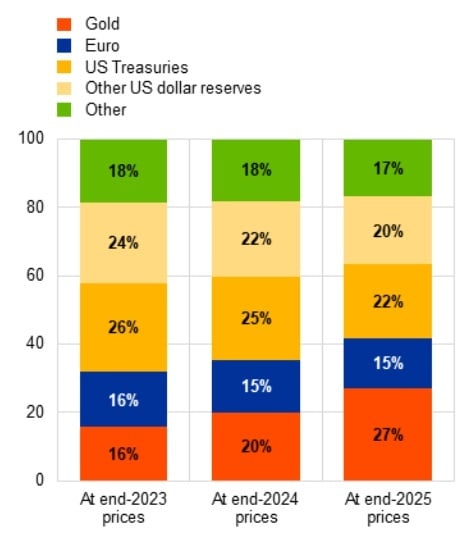
Adjusting for gold prices at the end of 2023 changes the picture. The ECB said the euro and gold would each account for 16% of official reserves, while U.S. Treasuries would remain higher at 26%. Gold also faces reserve limits. Its price is volatile, it pays no yield, physical holdings require storage, and supply cannot expand smoothly to meet liquidity demand.
Central Bank Demand Shows How Geopolitical Risk Is Reshaping Reserves
Central bank gold buying cooled in 2025, but stayed high by recent standards. Official-sector purchases reached about 850 tonnes, below the more than 1,000 tonnes bought annually from 2022 through 2024. Private investment demand nearly doubled from 2024 to almost 2,200 tonnes. Gold-backed exchange-traded funds also drew a record $89 billion in inflows.
The ECB linked official gold demand to diversification and geopolitical risk. Since Russia’s full-scale invasion of Ukraine, China has bought more than 350 tonnes. Poland added 320 tonnes, while Türkiye bought 220 tonnes and India acquired 130 tonnes. Poland remained the largest official-sector buyer in 2025. Stablecoin issuer Tether also bought more than 100 tonnes. The ECB said the purchase highlights how stablecoin growth could carry broader macroeconomic implications.
The ECB report said:
“ Gold purchases may also reflect efforts by some central banks to strengthen balance sheet resilience amid rising geopolitical risks.”
The data show a reserve system that remains dollar-centered, but less static. Gold’s price-driven lead could reverse if bullion falls. Still, sustained official demand suggests central banks want more protection from geopolitical shocks, market volatility, and dependence on any single reserve asset.