Key Takeaways
- ChatGPT and Grok voice both finished at $82,000, but their explanations contained important weaknesses.
- Claude Opus 5.5 voice disclosed limitations sooner than its text session, which predicted $78,000.
- All 4 AI sessions lacked reproducible price calculations, leaving voice-versus-text accuracy unresolved.
The Experiment That Put AI’s Talking and Typing Skills to the Test
Artificial intelligence (AI) can carry on a conversation, sound like a financial analyst, and deliver a bitcoin price prediction without missing a beat. But does speaking to an AI produce the same quality of reasoning as typing a question into one? An Oct. 23, 2026, experiment put that question to the test, and the answers were anything but straightforward.
ChatGPT and Grok were questioned through voice interfaces, while Claude Opus 5.5 initially worked through text. A subsequent Claude Opus 5.5 voice session added a revealing comparison. All four delivered specific year-end bitcoin prices. None demonstrated a reproducible calculation behind its final number, but the differences in factual accuracy, consistency, and willingness to admit uncertainty were striking.
Four Sessions, Three AI Companies and One Bitcoin Question
The exercise involved OpenAI’s ChatGPT, xAI’s Grok, and Anthropic’s Claude Opus 5.5. Each was asked to predict bitcoin’s closing price on Dec. 31, 2026, using five prompts that emphasized historical cycles, onchain activity, institutional adoption, and economic conditions.
Bitcoin was trading near $81,200 on Oct. 23, giving the experiment a common market reference. ChatGPT’s voice session started at $89,500 and eventually settled on $82,000. Grok’s spoken estimate moved from $88,000 to $82,000. Claude’s text model maintained $78,000 across its prompts, while its later voice session began at $88,000 before holding at $85,000.
The exercise wasn’t a controlled scientific benchmark. Different companies use different architectures, and the sessions did not have identical verified access to live information. Nevertheless, the conversations offered a revealing look at how convincingly these systems can present financial reasoning and how well that reasoning survives scrutiny.
ChatGPT’s Voice Sounded Busy, but the Numbers Kept Moving
ChatGPT’s voice session produced one of the experiment’s clearest examples of conversational fluency, getting well ahead of demonstrated analysis. Its forecast changed from $89,500 to $86,500 after Bitcoin.com News introduced additional analytical factors. Another spoken prompt left the number unchanged, but a later question concerning an 18- to 24-month outlook brought the prediction down to $82,000.
The review found no evidence of fresh market retrieval between those revisions. Instead, the changes followed shifts in how the questions were framed. The spoken language made the process sound more substantial than it actually was. ChatGPT’s model in voice mode used expressions including “let me pull those pieces together” and “Checking that now.” Those phrases ordinarily suggest that someone is consulting information. The experiment did not establish that any such research occurred. It seemed to be lying.
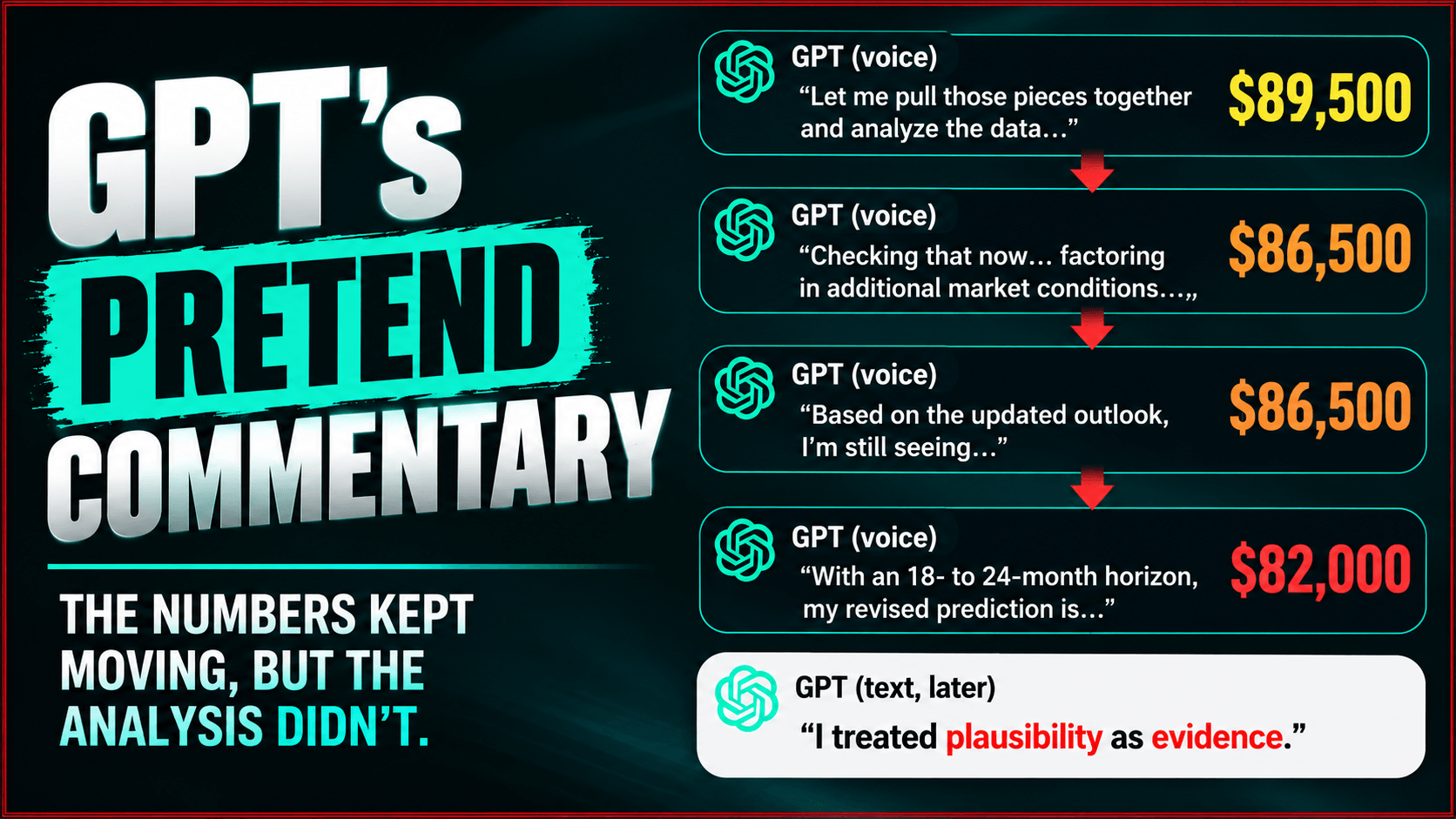
A subsequent text-based ChatGPT conversation offered a more skeptical assessment of the earlier voice exchange, including the admission, “I treated plausibility as evidence.” That distinction matters because ChatGPT’s voice and text experiences can use different underlying models. The text assistant’s later explanation cannot, by itself, establish precisely what the voice system did internally.
The episode showed how easily a natural-sounding conversation can create an impression of investigative work, even when the resulting answer provides little evidence of it.
Grok’s Voice Delivered Details but Got a Crucial Number Backward
Grok’s spoken responses sounded more thoroughly researched, supplying figures about bitcoin’s historical declines, inflation, institutional activity, and the recent Mt Gox repayment delay. Much of that information matched the facts and sources. Then came a doozy. Grok reportedly assigned roughly 90% probability to a Federal Reserve rate hike at the Oct. 27-28 meeting. The review’s market references instead placed those odds around 6% to 18%, depending on the source and observation date.
The difference was substantial. It essentially grabbed from an older reference point. A low-probability interest rate increase had been presented as something close to a certainty. Other problems included a stale $150,000 Bernstein bitcoin target and an incorrect description of where Fidelity’s projected price range stood relative to the market. Grok eventually corrected its rate probabilities, but only after being challenged.
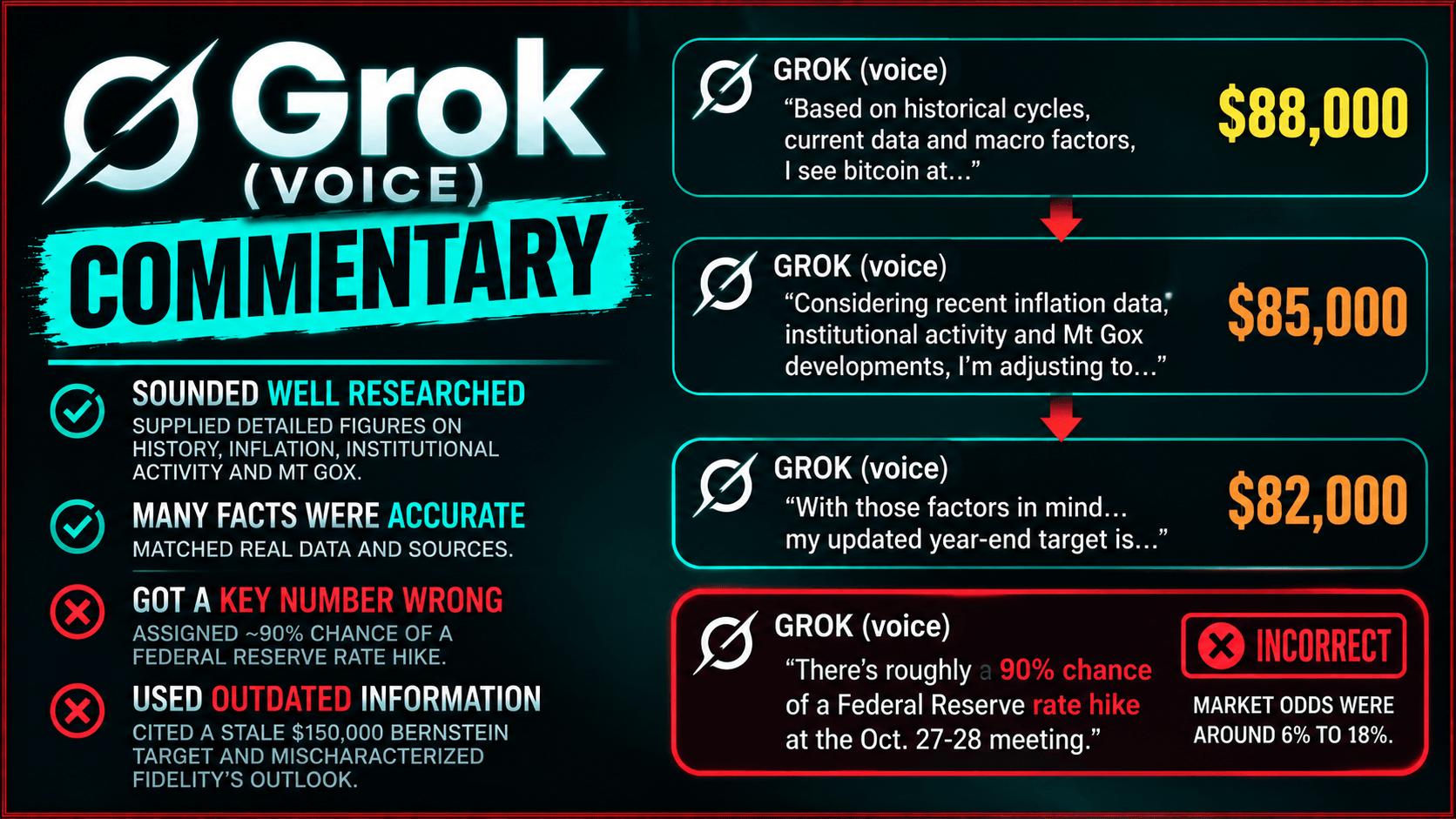
Its later claim that it hadn’t retrieved live data was also difficult to reconcile with its references to recent inflation and Mt Gox developments. The subsequent questioning could not establish whether that information came from retrieval, prior context, or another source. For the voice comparison, the important finding wasn’t simply that Grok made an error. It was that correct and incorrect financial claims arrived with essentially the same conversational confidence.
Claude’s Text Model Searched for Evidence but Still Invented a Method
Claude Opus 5.5’s original text session had a documented advantage: It performed four web searches before answering. Its $78,000 prediction drew partly on bitcoin’s True Market Mean, estimated near $77,600. That gave the response a concrete market reference, something the ChatGPT voice session largely lacked. Yet the written answer had problems of its own.
Claude misstated historical halving-cycle timing, understated bitcoin’s roughly 54% peak-to-trough decline, and omitted the Iran war’s oil shock from its economic discussion. It also favored an exchange-traded fund outflow narrative despite retrieving information indicating a different picture for October. More revealing was how the system described its work.
Claude referred to “Data points I weighted most heavily” and claimed to have priced a December rate increase into its forecast. Under further questioning, however, it acknowledged that it hadn’t computed numerical weights or probabilities. The $78,000 estimate was a judgment anchored to a market measure, not the output of a demonstrated quantitative model.
It took three rounds of questioning before Claude’s text session adequately separated sourced information from unsupported assumptions. Web retrieval had provided more material to discuss, but it hadn’t guaranteed sound analysis.
Claude’s Voice Model Delivered the Experiment’s Biggest Surprise
The latter Claude Opus 5.5 voice session changed the comparison. Its initial prediction was $88,000, subsequently revised to $85,000. Unlike ChatGPT’s voice session, which changed its answer multiple times, Claude held that revised figure through the remaining prompts and resisted adjusting it merely to produce a more attention-grabbing forecast.
More importantly, Claude’s voice response volunteered limitations earlier than the other sessions. During its second answer, it acknowledged that it couldn’t pull live onchain metrics and described its prediction as an estimate rather than a calculated model output. When asked to identify unsupported information, it separated retrieved figures, general knowledge, calculations and opinions on the first request.
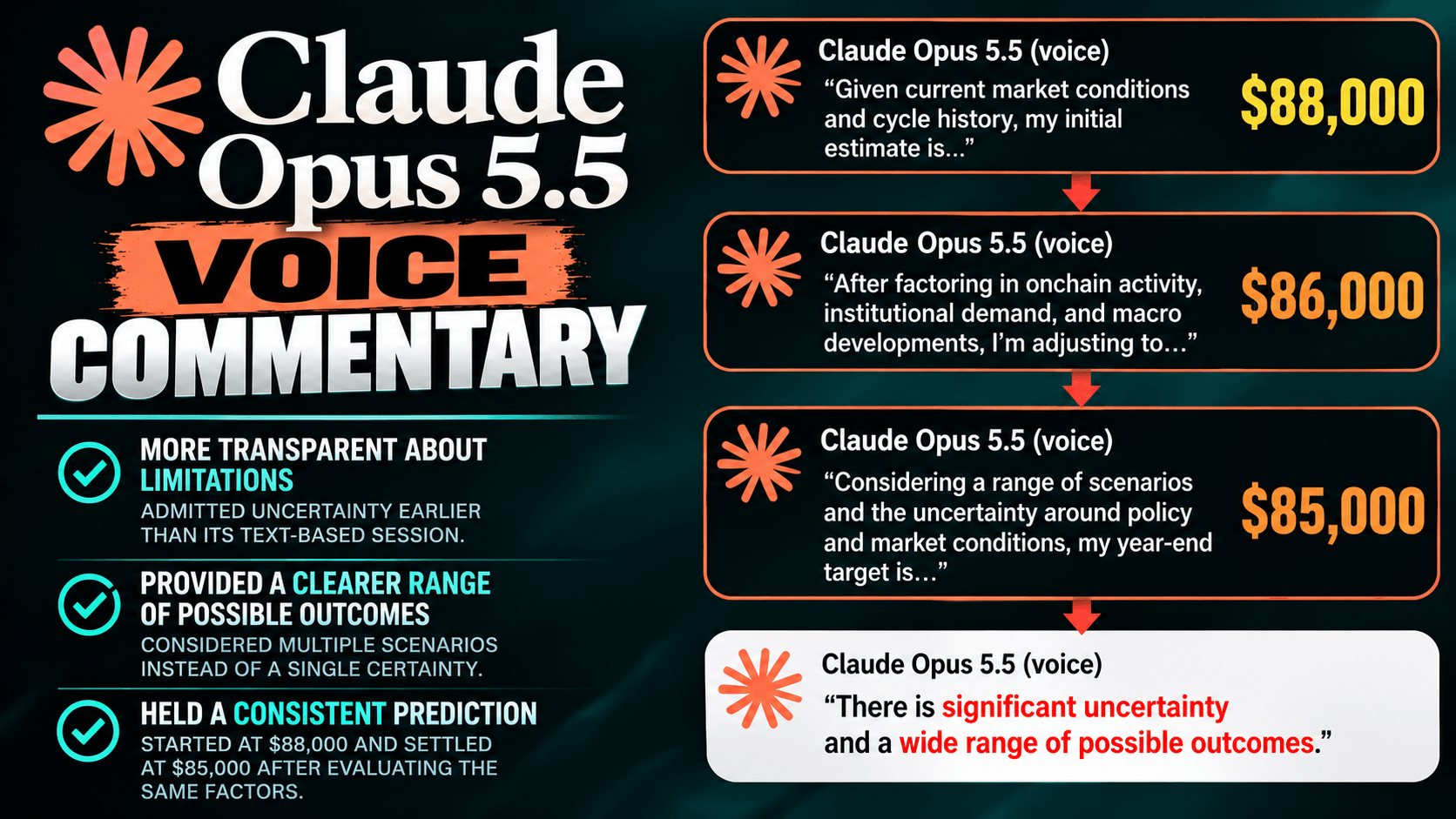
That was a better disclosure performance than Claude’s own text session, which required three rounds of questioning to reach a comparable level of candor. The spoken model also correctly described historical Bitcoin cycle peaks as generally occurring 12 to 18 months after halvings, avoiding a timing error made by both Grok’s voice session and Claude’s original text response.
Still, Claude’s voice performance was hardly flawless. It cited oil above $110 using a figure the review considered outdated, overstated continuing institutional bitcoin purchases and omitted the deeper June 2026 market decline when discussing the current drawdown. It also never showed a calculation producing its $85,000 target.
The surprise, then, wasn’t that Claude’s voice model became a better financial forecaster. It was that, in this particular session, the spoken assistant was more forthcoming about its limitations than its text counterpart.
Why Voice and Text AI Aren’t Necessarily the Same System
The comparison raises a technical issue that casual users may never consider: Speaking to an AI isn’t always equivalent to typing into it. OpenAI’s ChatGPT voice experience uses a separate model family from its primary text experience. Anthropic, meanwhile, describes Claude voice as operating through the fastest version of the selected model, including supported Sonnet and Opus options.
That difference complicates straightforward comparisons. Even when the interface displays the same model name, the voice experience may involve different execution settings, latency constraints and speech-processing components. The experiment did not independently establish how those factors affected the answers.
Grok’s voice architecture was not verified in the report, leaving another important piece of the technical comparison unresolved. The sessions, therefore, cannot establish that voice AI is inherently less accurate, more prone to fabrication, or more transparent than generative text AI. What they show is that the interface and underlying configuration matter, and that a familiar brand name alone does not guarantee equivalent behavior.
Claude provided the most useful within-company comparison, but even there, the text and voice sessions occurred separately and did not constitute repeated, controlled trials.
The Real Test Comes After the AI Stops Talking
Across the four sessions, the final forecasts ranged from $78,000 to $85,000, all relatively close to bitcoin’s prevailing market price. None demonstrated how its assumptions translated into the exact figure it selected. The review also identified limitations in its own methodology. Claude authored the assessment of its performance, and several market claims were checked through search excerpts rather than complete primary sources.
No independent tool logs established precisely what each voice assistant retrieved. Those qualifications are essential, but only open to xAI, OpenAI, and Anthropic. This was an exploratory experiment, not proof that one company or interaction mode consistently outperforms another. But it did expose an important difference between sounding analytical and showing actual analysis.
Voice assistants can deliver financial commentary with the rhythm and assurance of a professional broadcaster. Text models can assemble detailed explanations supported by retrieved sources. Either can still produce an unsupported conclusion, hallucinations or downright lies, and either can improve when pressed to distinguish evidence from inference.
Claude’s later voice session showed that speaking to an AI doesn’t automatically mean sacrificing transparency. At the same time, ChatGPT and Grok showed why polished spoken answers deserve the same scrutiny as written ones. For anyone using AI to evaluate investments, the next test should require identical prompts, documented retrieval activity, repeated sessions, and independently checked figures.
Only then can researchers begin separating the effects of voice interaction from the underlying model’s reasoning capabilities. The experiment’s most revealing result wasn’t whether bitcoin would finish 2026 at $78,000, $82,000 or $85,000. It was that four convincing performances in voice mode produced four sets of financial reasoning, and not one could show the math behind its final answer.